!pip install git+https://github.com/ECLIPSE-Lab/Ai4MatLectures.git "mdsdata>=0.1.5"MFML Week 3: Regression from Scratch
Loss minimization with TensileTestDataset

Learning Objectives
- Instantiate a
torch.utils.data.DatasetandDataLoader - Define a linear model as
nn.Module - Implement a manual training loop (MSE loss, SGD optimizer)
Setup
import torch
import torch.nn as nn
from torch.utils.data import DataLoader, random_split
from ai4mat.datasets import TensileTestDataset
import matplotlib.pyplot as plt
1. Load the Data
dataset = TensileTestDataset(temperature=600)
print(f"Dataset size: {len(dataset)}")
x0, y0 = dataset[0]
print(f"Sample x (strain): {x0}, shape: {x0.shape}")
print(f"Sample y (stress): {y0:.2f} MPa")
Dataset size: 350
Sample x (strain): tensor([0.0001]), shape: torch.Size([1])
Sample y (stress): -0.13 MPaX_all = torch.stack([dataset[i][0] for i in range(len(dataset))]).squeeze()
y_all = torch.stack([dataset[i][1] for i in range(len(dataset))])
plt.scatter(X_all.numpy(), y_all.numpy(), s=8, alpha=0.5)
plt.xlabel("Strain")
plt.ylabel("Stress (MPa)")
plt.title("Tensile Test Data (600°C)")
plt.tight_layout()
plt.show()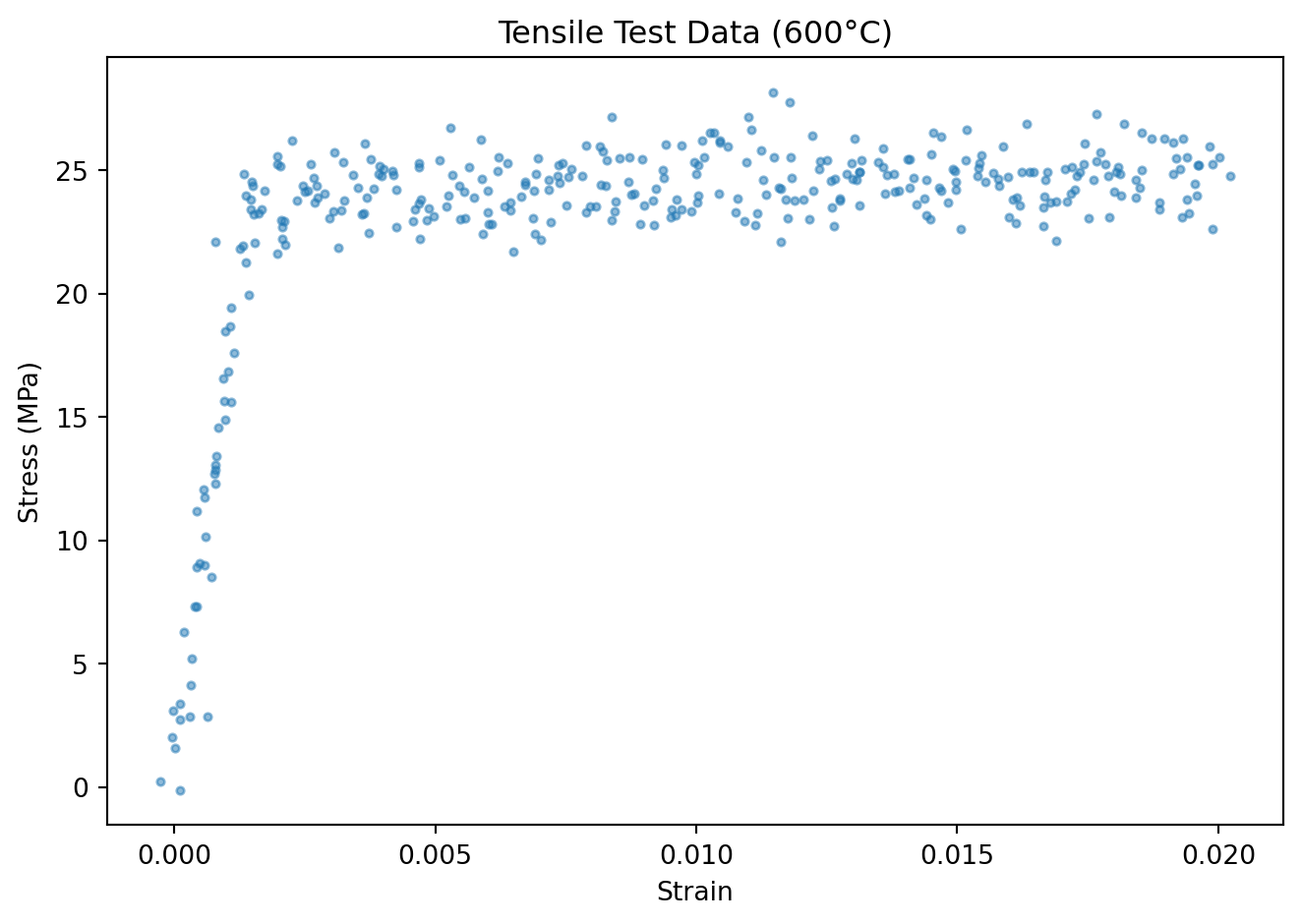
2. Train/Val Split
n_train = int(0.8 * len(dataset))
n_val = len(dataset) - n_train
train_ds, val_ds = random_split(dataset, [n_train, n_val])

train_loader = DataLoader(train_ds, batch_size=32, shuffle=True)
val_loader   = DataLoader(val_ds,   batch_size=32, shuffle=False)
print(f"Train: {n_train} | Val: {n_val}")
Train: 280 | Val: 703. Define the Model
class LinearModel(nn.Module):
    def __init__(self):
        super().__init__()
        self.linear = nn.Linear(1, 1)

    def forward(self, x):
        return self.linear(x).squeeze(-1)

model = LinearModel()
print(model)
print(f"Parameters: {sum(p.numel() for p in model.parameters())}")
LinearModel(
(linear): Linear(in_features=1, out_features=1, bias=True)
)
Parameters: 24. Training Loop
criterion = nn.MSELoss()
optimizer = torch.optim.SGD(model.parameters(), lr=1e-4)

train_losses, val_losses = [], []

for epoch in range(100):
    model.train()
    epoch_loss = 0.0
    for x_batch, y_batch in train_loader:
        optimizer.zero_grad()
        y_pred = model(x_batch)
        loss = criterion(y_pred, y_batch)
        loss.backward()
        optimizer.step()
        epoch_loss += loss.item() * len(x_batch)
    train_losses.append(epoch_loss / n_train)

    model.eval()
    val_loss = 0.0
    with torch.no_grad():
        for x_batch, y_batch in val_loader:
            y_pred = model(x_batch)
            val_loss += criterion(y_pred, y_batch).item() * len(x_batch)
    val_losses.append(val_loss / n_val)

plt.plot(train_losses, label='Train MSE')
plt.plot(val_losses, label='Val MSE')
plt.xlabel("Epoch")
plt.ylabel("MSE Loss")
plt.legend()
plt.title("Training Curve")
plt.tight_layout()
plt.show()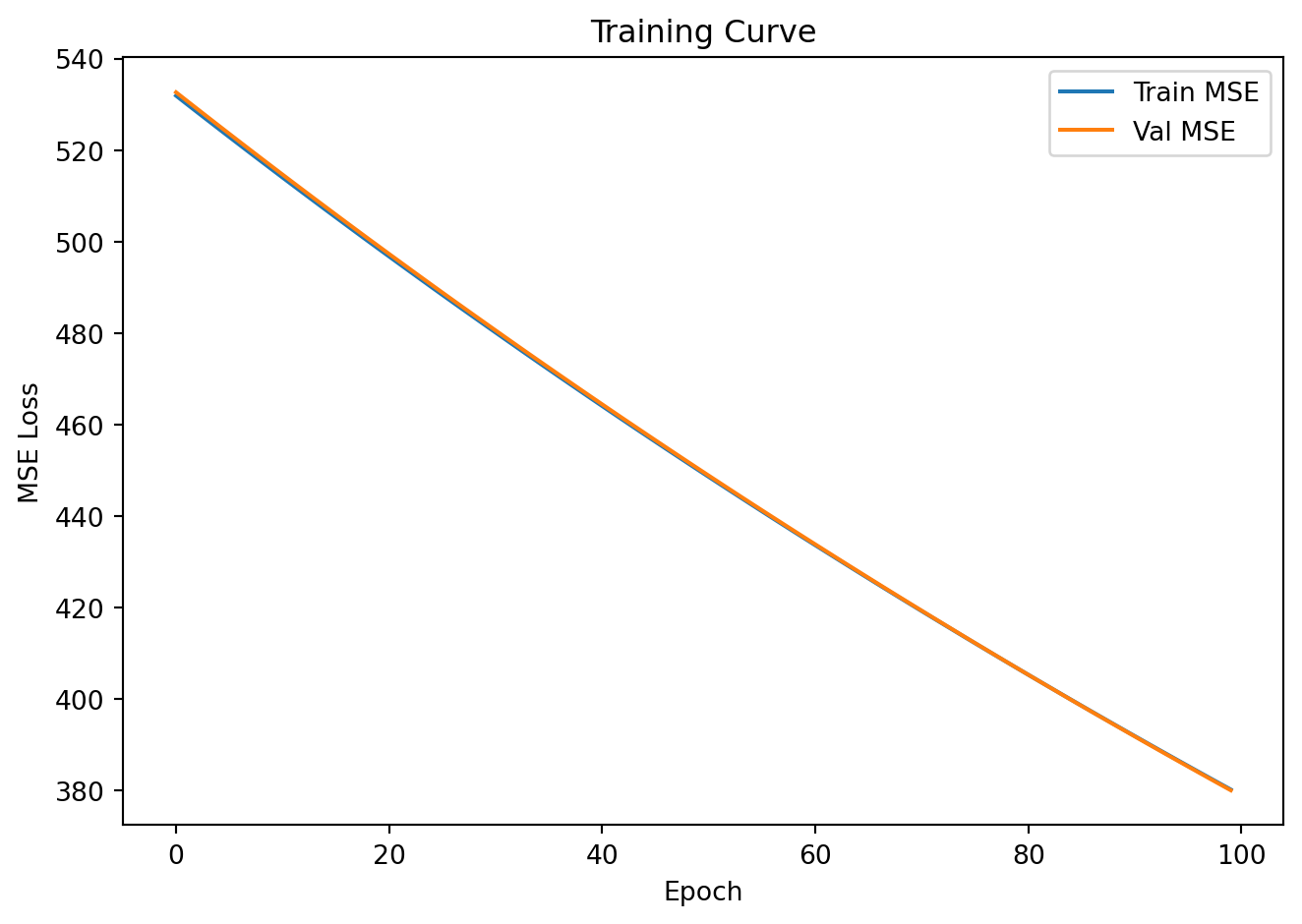
5. Evaluation
model.eval()
with torch.no_grad():
    X_tensor = torch.stack([dataset[i][0] for i in range(len(dataset))])
    y_pred_all = model(X_tensor).numpy()

order = X_all.numpy().argsort()
plt.scatter(X_all.numpy(), y_all.numpy(), s=8, alpha=0.3, label='Data')
plt.plot(X_all.numpy()[order], y_pred_all[order], color='red', label='Linear fit')
plt.xlabel("Strain")
plt.ylabel("Stress (MPa)")
plt.legend()
plt.title("Linear Model Fit")
plt.tight_layout()
plt.show()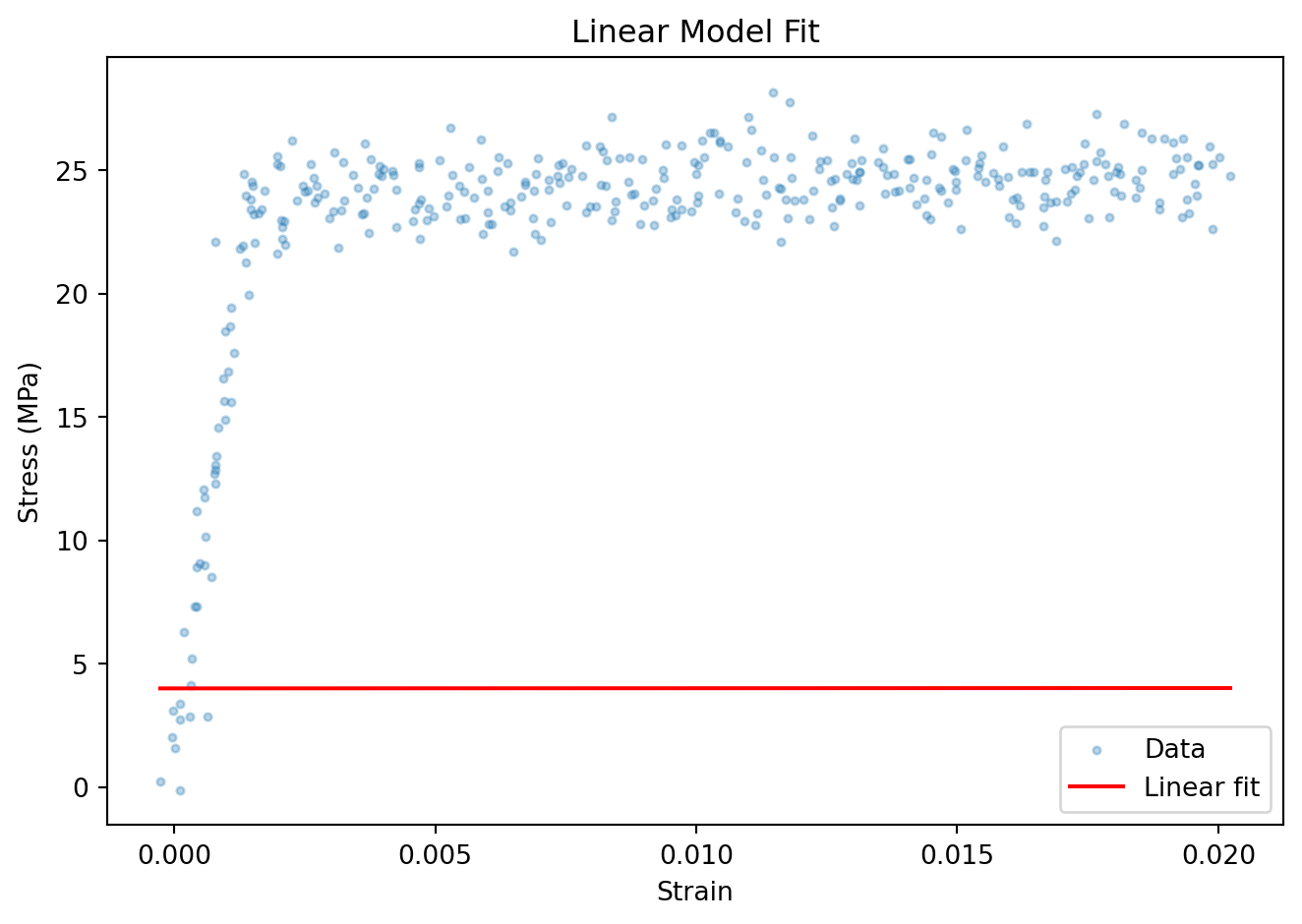
Exercises
- Change
temperatureto0or400inTensileTestDataset. How does the curve shape change? Does linear regression still work well? - Replace
LinearModelwith a 2-layer MLP:nn.Sequential(nn.Linear(1,16), nn.ReLU(), nn.Linear(16,1)). Does the fit improve? - Increase the learning rate to
1e-3. What happens to training? What does this tell you about loss landscape conditioning?