!pip install git+https://github.com/ECLIPSE-Lab/Ai4MatLectures.git "mdsdata>=0.1.5"MFML Week 7: Overfitting and Regularization
Bias-variance tradeoff with IsingDataset (light)

Learning Objectives
- Observe overfitting via train/val loss divergence for different model sizes
- Understand the bias-variance tradeoff empirically
- Apply L2 regularization via
weight_decayin the optimizer
Setup
import torch
import torch.nn as nn
from torch.utils.data import DataLoader, random_split
from ai4mat.datasets import IsingDataset
import matplotlib.pyplot as plt
1. Load the Data
dataset = IsingDataset(size='light')
print(f"Dataset size: {len(dataset)}")
x0, y0 = dataset[0]
print(f"Sample x shape: {x0.shape}, dtype: {x0.dtype}")
print(f"Sample y: {y0}, dtype: {y0.dtype}")
print(f"Classes: {torch.unique(torch.tensor([dataset[i][1] for i in range(len(dataset))])).tolist()}")
Dataset size: 5000
Sample x shape: torch.Size([1, 16, 16]), dtype: torch.float32
Sample y: 1, dtype: torch.int64
Classes: [0, 1]# Visualize a few Ising configurations
fig, axes = plt.subplots(2, 6, figsize=(14, 5))
label_names = {0: "Disordered (T > Tc)", 1: "Ordered (T < Tc)"}
for i, ax in enumerate(axes.flat):
img = dataset[i][0].squeeze().numpy()
ax.imshow(img, cmap='gray', vmin=0, vmax=1)
ax.set_title(f"y={dataset[i][1].item()}", fontsize=8)
ax.axis('off')
plt.suptitle("Ising spin configurations (16×16)")
plt.tight_layout()
plt.show()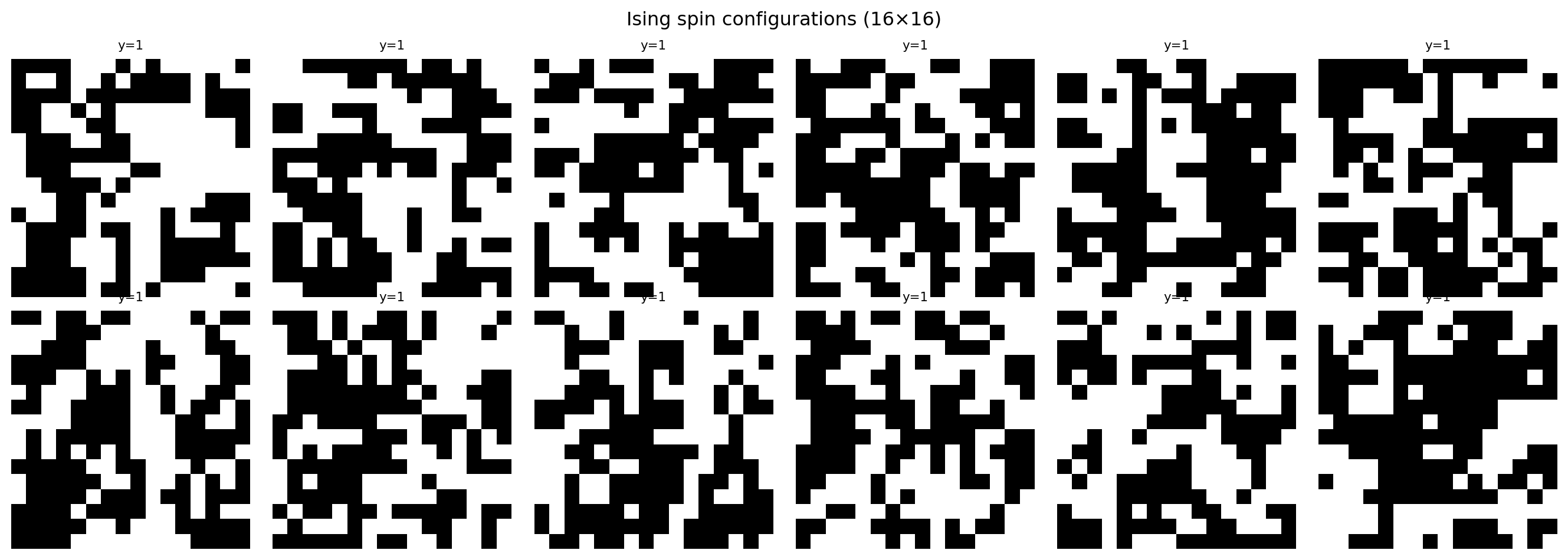
2. Train/Val Split
n_train = int(0.8 * len(dataset))
n_val = len(dataset) - n_train
train_ds, val_ds = random_split(dataset, [n_train, n_val])

train_loader = DataLoader(train_ds, batch_size=64, shuffle=True)
val_loader   = DataLoader(val_ds,   batch_size=64, shuffle=False)
print(f"Train: {n_train} | Val: {n_val}")
Train: 4000 | Val: 10003. Three Model Variants
We define three models of increasing capacity to illustrate the bias-variance tradeoff.
def make_underfit():
    """Underfitting: too few parameters to capture the decision boundary."""
    return nn.Sequential(
        nn.Flatten(),
        nn.Linear(256, 2)
    )

def make_goodfit():
    """Good fit: moderate capacity, good generalization."""
    return nn.Sequential(
        nn.Flatten(),
        nn.Linear(256, 64),
        nn.ReLU(),
        nn.Linear(64, 2)
    )

def make_overfit():
    """Overfitting: too many parameters, memorizes training data."""
    return nn.Sequential(
        nn.Flatten(),
        nn.Linear(256, 256),
        nn.ReLU(),
        nn.Linear(256, 256),
        nn.ReLU(),
        nn.Linear(256, 2)
    )

for name, fn in [("Underfit", make_underfit), ("Good fit", make_goodfit), ("Overfit", make_overfit)]:
    m = fn()
    n_params = sum(p.numel() for p in m.parameters())
    print(f"{name:12s}: {n_params:>7,} parameters")
Underfit : 514 parameters
Good fit : 16,578 parameters
Overfit : 132,098 parameters4. Training Loop
def train_model(model, train_loader, val_loader, n_train, n_val,
                lr=1e-3, weight_decay=0.0, epochs=50):
    criterion = nn.CrossEntropyLoss()
    optimizer = torch.optim.Adam(model.parameters(), lr=lr, weight_decay=weight_decay)
    train_losses, val_losses = [], []

    for epoch in range(epochs):
        model.train()
        ep_loss = 0.0
        for x_batch, y_batch in train_loader:
            optimizer.zero_grad()
            loss = criterion(model(x_batch), y_batch)
            loss.backward()
            optimizer.step()
            ep_loss += loss.item() * len(x_batch)
        train_losses.append(ep_loss / n_train)

        model.eval()
        v_loss = 0.0
        with torch.no_grad():
            for x_batch, y_batch in val_loader:
                v_loss += criterion(model(x_batch), y_batch).item() * len(x_batch)
        val_losses.append(v_loss / n_val)

    return train_losses, val_losses

# Train all three models
torch.manual_seed(0)
results = {}
for name, fn in [("Underfit", make_underfit), ("Good fit", make_goodfit), ("Overfit", make_overfit)]:
    model = fn()
    tl, vl = train_model(model, train_loader, val_loader, n_train, n_val)
    results[name] = (tl, vl)
    print(f"{name:12s} — final train loss: {tl[-1]:.4f}, val loss: {vl[-1]:.4f}")
Underfit — final train loss: 0.6691, val loss: 0.7331
Good fit — final train loss: 0.0023, val loss: 0.2267
Overfit — final train loss: 0.0000, val loss: 0.36305. Compare Learning Curves
fig, axes = plt.subplots(1, 3, figsize=(15, 4))
colors = {'train': 'tab:blue', 'val': 'tab:orange'}

for ax, (name, (tl, vl)) in zip(axes, results.items()):
    ax.plot(tl, label='Train', color=colors['train'])
    ax.plot(vl, label='Val',   color=colors['val'])
    ax.set_title(name)
    ax.set_xlabel("Epoch")
    ax.set_ylabel("Cross-Entropy Loss")
    ax.legend()
    ax.set_ylim(0, max(max(tl), max(vl)) * 1.1)

plt.suptitle("Bias-Variance Tradeoff: Train vs Val Loss", fontsize=13)
plt.tight_layout()
plt.show()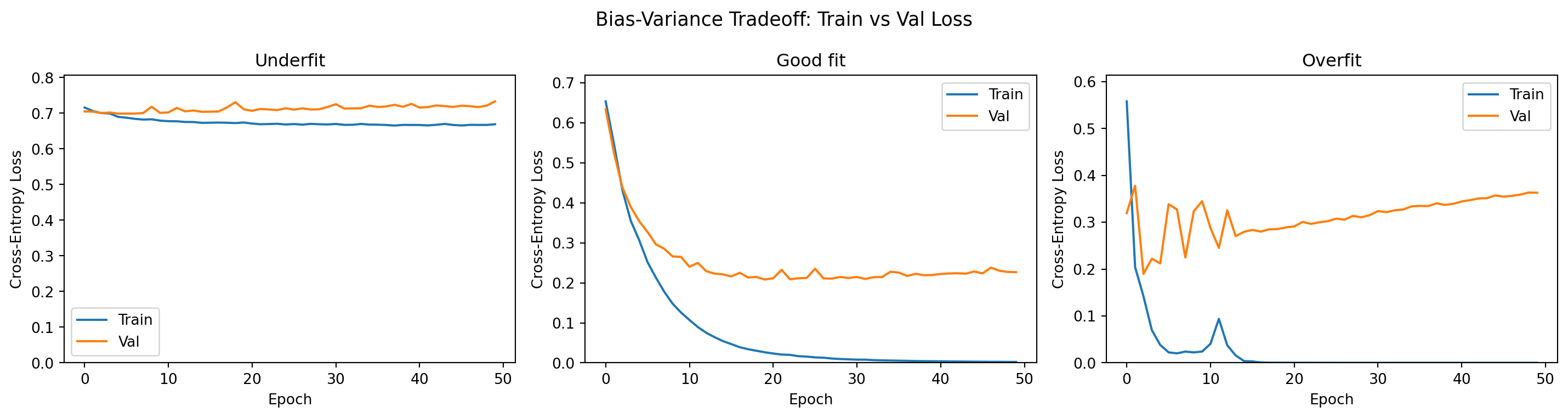
6. Regularization with Weight Decay
The overfitting model can be tamed by adding L2 regularization (weight_decay in Adam).
torch.manual_seed(0)
overfit_model_reg = make_overfit()
tl_reg, vl_reg = train_model(overfit_model_reg, train_loader, val_loader,
                              n_train, n_val, weight_decay=1e-4)

overfit_tl, overfit_vl = results["Overfit"]

plt.figure(figsize=(8, 4))
plt.plot(overfit_tl, '--', color='tab:blue',   label='Overfit — train (no reg)')
plt.plot(overfit_vl, '--', color='tab:orange', label='Overfit — val (no reg)')
plt.plot(tl_reg,     '-',  color='tab:blue',   label='Overfit — train (weight_decay=1e-4)')
plt.plot(vl_reg,     '-',  color='tab:orange', label='Overfit — val (weight_decay=1e-4)')
plt.xlabel("Epoch")
plt.ylabel("Cross-Entropy Loss")
plt.title("Effect of L2 Regularization on Overfit Model")
plt.legend(fontsize=8)
plt.tight_layout()
plt.show()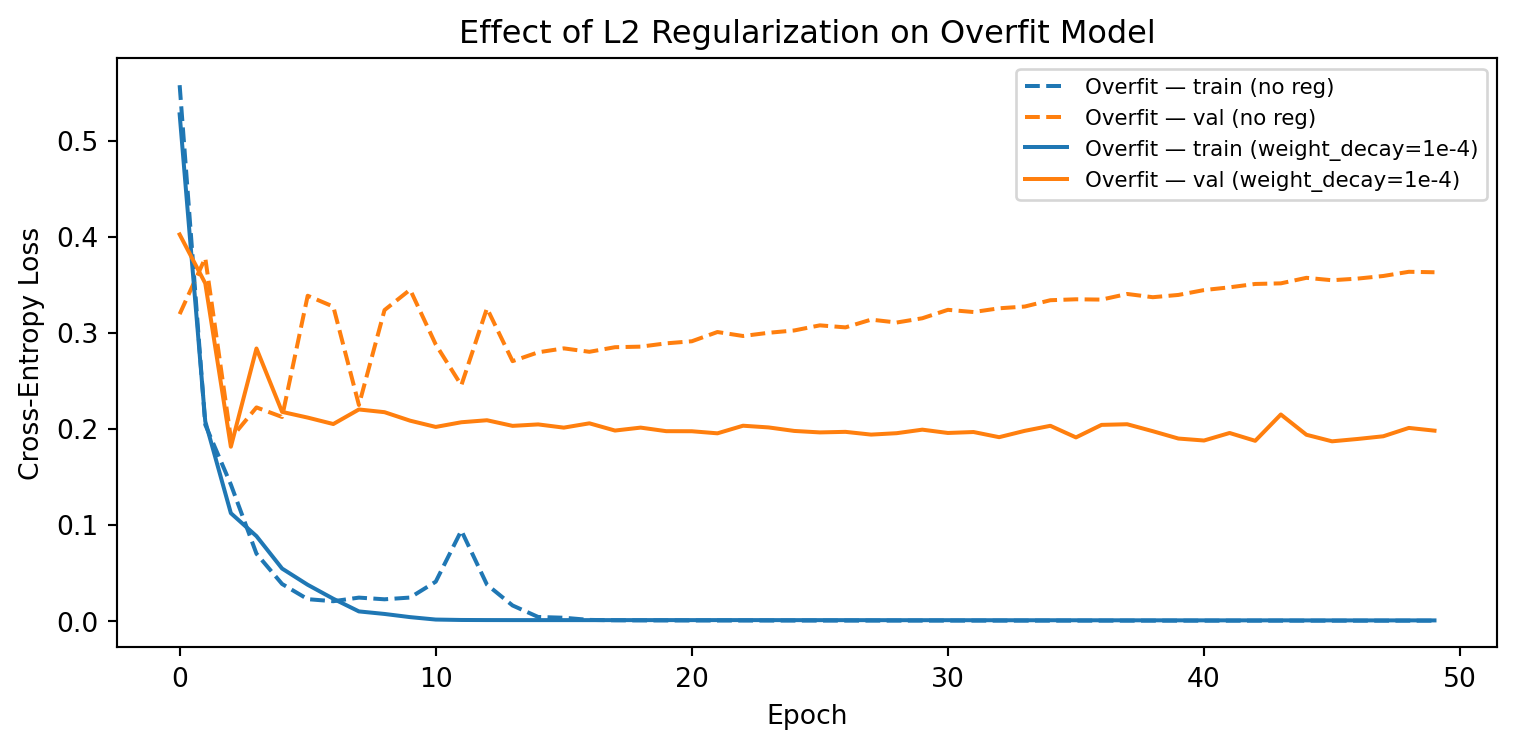
Exercises
- At what model size (number of parameters) does overfitting first appear? Train a model with one extra layer in the “Good fit” config and observe the learning curves.
- Try
weight_decay=1e-2vs1e-4vs0for the overfit model. How does the gap between train and val loss change? - Add
nn.Dropout(0.5)after eachnn.ReLU()in the overfit model. Does dropout reduce overfitting as effectively as weight decay?