Data Science for Electron Microscopy
Week 3: Linear algebra & PCA you actually need


Prof. Dr. Philipp Pelz

FAU Erlangen-Nürnberg

Institute of Micro- and Nanostructure Research

FAU Logo IMN Logo CENEM Logo ERC Logo Eclipse Logo

Recap: where we left off

  • Week 2: What is learning? EM data tensors, Poisson noise, SNR = √λ.
  • You can now simulate a noisy STEM image, measure its SNR, and explain why dose quadruples to double it.
  • Every EM pixel is a count — Poisson statistics, signal-dependent variance.
  • Gap: to do anything useful with a stack of 50 000 EELS spectra, we need a compact, interpretable representation.
  • Today: the minimum linear algebra to build that representation, culminating in PCA as the workhorse for EM spectral denoising.

Today’s question

  • Why does PCA denoise an EELS spectrum image? Because signal lives in a low-dimensional subspace; noise spreads across all directions.
  • How do we find that subspace? Singular Value Decomposition — the same three-step picture you can draw without any formulas.
  • Road map: vectors & matrices as geometry (5) · projection (4) · SVD picture (5) · PCA = max-variance directions (6) · scree plot (4) · PCA denoising (6) · eigen-spectra (3) · ill-conditioning (3) · limits + forward link (2).
  • Self-study: notebooks/week03_pca_eels.ipynb — build a synthetic EELS stack, compute PCA, denoise, choose k from the scree plot.

Vectors: arrows in space

  • A vector \(\mathbf{x} \in \mathbb{R}^D\) is a point (or arrow) in \(D\)-dimensional space.
  • In EM: one EELS spectrum with 200 energy channels is a point in \(\mathbb{R}^{200}\).
  • The dot product \(\mathbf{a}^T \mathbf{b} = |\mathbf{a}||\mathbf{b}|\cos\theta\) measures the alignment between two vectors.
  • Dot product = 0 ⟹ orthogonal (90°) — the two vectors carry independent information.
  • Norm \(\|\mathbf{a}\| = \sqrt{\mathbf{a}^T\mathbf{a}}\) = the length of the arrow.

Projection: the core operation

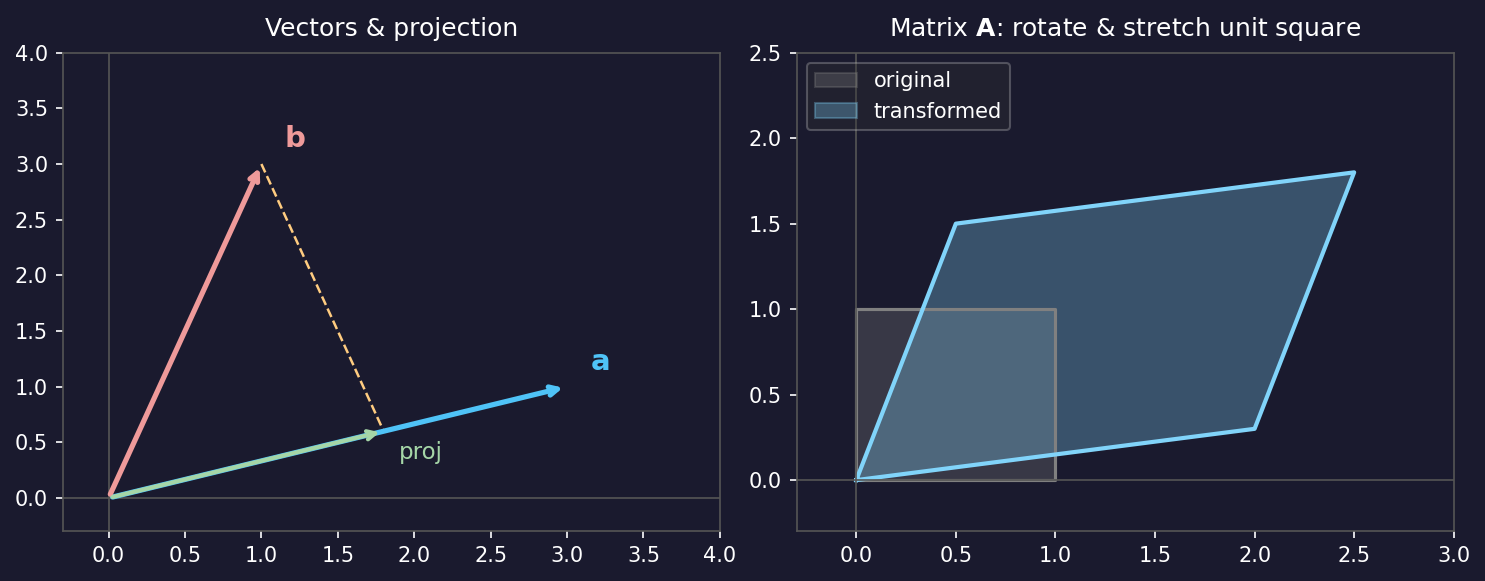
Projection of \(\mathbf{b}\) onto the direction of \(\mathbf{a}\); the residual (orange dashed) is orthogonal.
  • Scalar projection of \(\mathbf{b}\) onto unit vector \(\hat{\mathbf{a}}\): \(c = \hat{\mathbf{a}}^T \mathbf{b}\).
  • Vector projection: \(\text{proj}_{\mathbf{a}} \mathbf{b} = c \, \hat{\mathbf{a}}\).
  • The residual \(\mathbf{b} - \text{proj}_{\mathbf{a}}\mathbf{b}\) is perpendicular to \(\mathbf{a}\).
  • This decomposition — “how much lies along \(\mathbf{a}\)?” — is what PCA does in every direction.

Matrices as geometric transformations
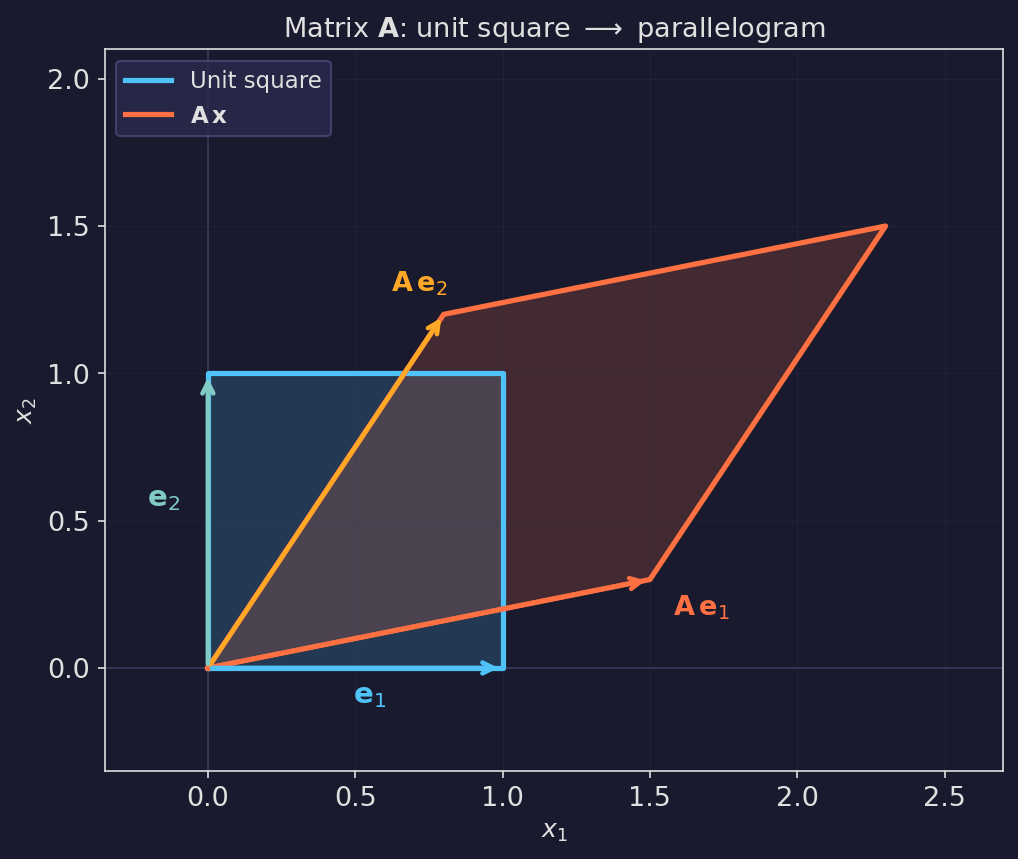
A \(2\times2\) matrix applied to the unit square: rotates, stretches, and shears — the unit square (blue) becomes a parallelogram (orange).
  • A matrix \(\mathbf{A}\) maps every vector \(\mathbf{x}\) to a new vector \(\mathbf{y} = \mathbf{Ax}\).
  • Geometrically: \(\mathbf{A}\) rotates, stretches, and (for non-symmetric \(\mathbf{A}\)) shears space.
  • The data matrix \(\mathbf{X} \in \mathbb{R}^{N \times D}\): \(N\) spectra (rows), each with \(D\) energy channels (columns).
  • One row = one spectrum = one point in \(\mathbb{R}^D\).
  • Convention for this week: observations in rows, features in columns.

The data matrix: EM spectra as points in high-D space
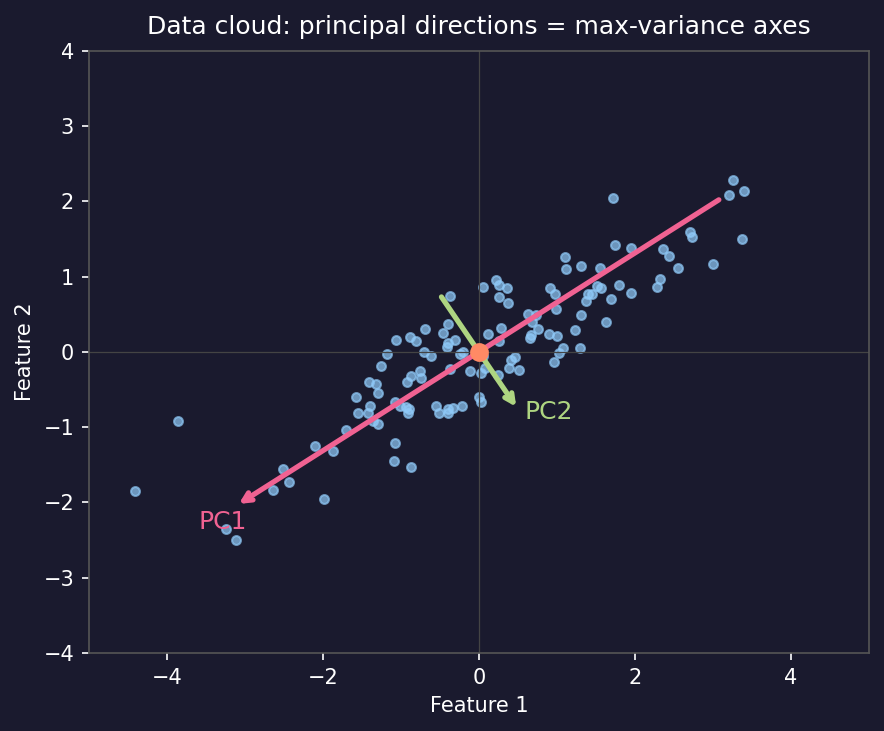
Data cloud with principal directions (arrows): PC1 = direction of maximum spread, PC2 = orthogonal residual.
  • Each EELS spectrum \(\mathbf{x}_i \in \mathbb{R}^{1024}\) is a point in 1024-D space.
  • The cloud of \(N\) spectra occupies only a tiny corner of that space — most directions are empty.
  • Intrinsic dimensionality: if a sample has \(K\) distinct chemical phases, the spectra approximately lie on a \(K\)-dimensional subspace.
  • Key intuition: for a two-phase sample, all spectra are linear combinations of two end-members → they lie on a 2-D plane inside \(\mathbb{R}^{1024}\).
  • PCA finds and extracts that plane.

Reshaping EM data into a matrix: the practical step

import numpy as np

# Simulate loading an EELS spectrum image
# Shape: (ny, nx, energy_channels) = (64, 64, 1024)
eels_map = np.random.rand(64, 64, 1024).astype(np.float32)

ny, nx, ne = eels_map.shape
print("Original shape:", eels_map.shape)   # (64, 64, 1024)

# Reshape: stack all pixels into rows → data matrix
X = eels_map.reshape(ny * nx, ne)
print("Data matrix shape:", X.shape)        # (4096, 1024) — N=4096 spectra, D=1024 channels

# After PCA: reshape score maps back to spatial image
# (assume K=3 components)
K = 3
# scores.shape = (4096, 3)  →  reshape to (64, 64, 3)
# score_maps = scores.reshape(ny, nx, K)
print(f"Score maps after reshape: ({ny}, {nx}, {K}) = {ny*nx*K} values total")
  • Data layout rule: observations (pixels, spectra) in rows; features (channels) in columns.
  • Always check X.shape before any analysis — a transposed matrix gives meaningless PCA.

Projection onto a subspace

  • Suppose we want to approximate a spectrum \(\mathbf{x}\) using only \(K\) basis vectors \(\{\mathbf{v}_1, \ldots, \mathbf{v}_K\}\).
  • The best approximation (minimum reconstruction error) is the orthogonal projection: \[\hat{\mathbf{x}} = \sum_{k=1}^{K} (\mathbf{v}_k^T \mathbf{x})\, \mathbf{v}_k = \mathbf{V}_K \mathbf{V}_K^T \mathbf{x}.\]
  • The coefficients \(c_k = \mathbf{v}_k^T \mathbf{x}\) are called scores — how much of \(\mathbf{x}\) lies along \(\mathbf{v}_k\).
  • Residual: \(\mathbf{x} - \hat{\mathbf{x}}\) is orthogonal to every \(\mathbf{v}_k\) — it contains whatever the \(K\) basis vectors could not explain.
  • If the basis vectors capture signal, the residual contains noise.

Least squares = projection (no calculus required)

  • Problem: find weights \(\mathbf{w}\) such that \(\mathbf{Xw} \approx \mathbf{y}\) (predict target \(\mathbf{y}\) from features \(\mathbf{X}\)).
  • Geometric view: \(\mathbf{Xw}\) can only reach the column space of \(\mathbf{X}\).
  • The best approximation is the orthogonal projection of \(\mathbf{y}\) onto that column space.
  • Orthogonality condition: the residual \(\mathbf{r} = \mathbf{y} - \mathbf{Xw}\) must be perpendicular to every column of \(\mathbf{X}\), i.e. \(\mathbf{X}^T \mathbf{r} = \mathbf{0}\).
  • Substituting: \(\mathbf{X}^T(\mathbf{y} - \mathbf{Xw}) = \mathbf{0}\)Normal equations: \(\mathbf{X}^T\mathbf{X}\,\hat{\mathbf{w}} = \mathbf{X}^T \mathbf{y}\) Bishop, Christopher M., (2006).

Inner product and orthonormal bases: the computational engine

  • Orthonormal basis \(\{\mathbf{v}_1, \ldots, \mathbf{v}_K\}\): each vector has unit length and all pairs are perpendicular.
    • Formally: \(\mathbf{v}_i^T \mathbf{v}_j = \delta_{ij}\) (= 1 if \(i=j\), else 0).
  • Computational advantage: to find the coefficient of \(\mathbf{x}\) along \(\mathbf{v}_k\), just compute one dot product: \(c_k = \mathbf{v}_k^T \mathbf{x}\).
  • No matrix inversion needed — orthonormality makes the “inverse” trivial.
  • PCA principal components are orthonormal: each eigenspectrum has unit norm; different eigenspectra are perpendicular.
  • This means the scores for different PCs are uncorrelated — a crucial property for interpretation.

Projection intuition in 3-D

  • Imagine a cloud of 3-D points (atoms in a grain boundary, spectra from a 3-phase sample).
  • Most of the variance (spread) lies along one principal direction — call it \(\mathbf{v}_1\).
  • Projecting every point onto \(\mathbf{v}_1\) gives a 1-D summary that preserves most information.
  • Adding \(\mathbf{v}_2\) (orthogonal to \(\mathbf{v}_1\)) captures the next largest spread, and so on.
  • PCA finds \(\mathbf{v}_1, \mathbf{v}_2, \ldots\) in order of decreasing variance — this is exact.
  • Key property: \(K\) projections capture more variance than any other set of \(K\) directions — PCA is optimal.

The covariance matrix: where geometry meets statistics

  • Covariance matrix of centered data: \(\mathbf{S} = \frac{1}{N-1}\tilde{\mathbf{X}}^T\tilde{\mathbf{X}} \in \mathbb{R}^{D \times D}\).
  • Entry \(S_{ij}\) = covariance between energy channels \(i\) and \(j\); \(S_{ii}\) = variance of channel \(i\).
  • Geometry: the level set \(\mathbf{x}^T\mathbf{S}^{-1}\mathbf{x} = 1\) is an ellipsoid whose axes are the eigenvectors of \(\mathbf{S}\) with lengths \(\propto \sqrt{\lambda_k}\) (eigenvalues).
  • PCA = align the coordinate axes with the ellipsoid axes: rotate to the eigenbasis of \(\mathbf{S}\), where features are uncorrelated.
  • In EM: off-diagonal entries of \(\mathbf{S}\) are large when two energy channels always increase or decrease together (e.g. Fe-L23 channels are correlated because they all belong to the same edge).

SVD: the rotate–stretch–rotate decomposition
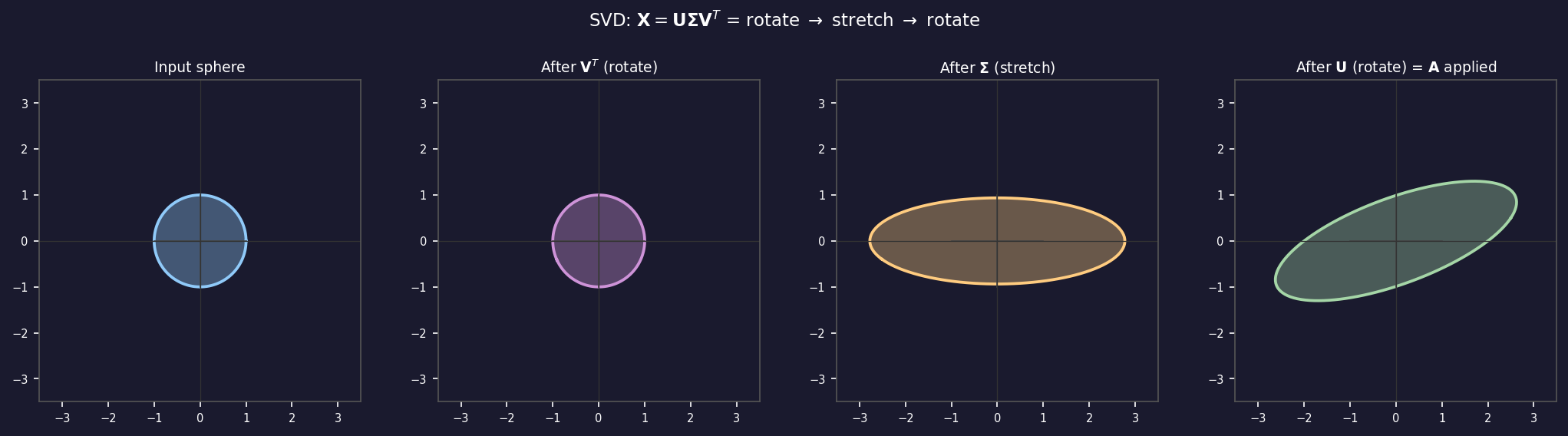
SVD applied to a unit circle: (1) rotate by \(\mathbf{V}^T\), (2) stretch by \(\mathbf{\Sigma}\), (3) rotate by \(\mathbf{U}\) — the result is an ellipse.
  • Any matrix \(\mathbf{X}\) (data matrix or otherwise) can be written as: \[\mathbf{X} = \mathbf{U} \boldsymbol{\Sigma} \mathbf{V}^T.\]
  • \(\mathbf{V}\): right singular vectors — input rotation (principal directions in feature space).
  • \(\boldsymbol{\Sigma}\): singular values on the diagonal — how much each direction is stretched.
  • \(\mathbf{U}\): left singular vectors — output rotation (scores in observation space).

SVD factors: what each part means

  • \(\mathbf{X} = \mathbf{U} \boldsymbol{\Sigma} \mathbf{V}^T\) for a data matrix \(\mathbf{X} \in \mathbb{R}^{N \times D}\) (N spectra, D channels):
  • \(\mathbf{V}\) (\(D \times D\)): columns are eigenspectra — the “spectral shapes” that make up the data.
  • \(\boldsymbol{\Sigma}\) (\(N \times D\), diagonal): singular values \(\sigma_1 \geq \sigma_2 \geq \ldots \geq 0\) — the importance of each eigenspectrum.
  • \(\mathbf{U}\) (\(N \times N\)): columns are score maps — how strongly each eigenspectrum is expressed at each pixel.
  • Compact notation: \(\mathbf{X} \approx \sum_{k=1}^{K} \sigma_k \, \mathbf{u}_k \mathbf{v}_k^T\) — a sum of \(K\) rank-1 “spectral images.”

SVD and low-rank approximation (Eckart–Young)

  • Truncated SVD: keep only the top \(k\) singular values; set the rest to zero.
  • Result: \(\hat{\mathbf{X}}_k = \mathbf{U}_k \boldsymbol{\Sigma}_k \mathbf{V}_k^T\), where subscript \(k\) means “first \(k\) columns.”
  • Optimality (Eckart–Young theorem): \(\hat{\mathbf{X}}_k\) is the best rank-\(k\) approximation of \(\mathbf{X}\) in the sense of minimising the Frobenius norm of the reconstruction error: \[\| \mathbf{X} - \hat{\mathbf{X}}_k \|_F = \sqrt{\sigma_{k+1}^2 + \sigma_{k+2}^2 + \cdots}.\]
  • Denoising: if signal lives in rank-\(k\) and noise spreads over all ranks, truncation removes noise.
  • In Python: U, s, Vt = np.linalg.svd(X, full_matrices=False) — then zero out s[k:].

PCA: directions of maximum variance

  • PCA finds the orthonormal directions \(\mathbf{v}_1, \mathbf{v}_2, \ldots\) that maximise the variance of the projected data.
  • Mathematically: PC1 maximises \(\text{Var}(\mathbf{X}\mathbf{v})\) subject to \(\|\mathbf{v}\|=1\).
  • Solution: \(\mathbf{v}_1\) is the first right singular vector of the centered data matrix.
  • PC2 maximises variance subject to \(\mathbf{v}_2 \perp \mathbf{v}_1\) — and so on.
  • Equivalently: PCA diagonalises the covariance matrix \(\mathbf{S} = \frac{1}{N-1}\mathbf{X}^T\mathbf{X}\) (after centering).
  • The eigenvalues \(\lambda_k = \sigma_k^2/(N-1)\) are the variances along each principal component.

Scores and loadings: PCA outputs in EM

  • After centering \(\mathbf{X}\) (subtract mean spectrum): \(\tilde{\mathbf{X}} = \mathbf{X} - \bar{\mathbf{x}}\mathbf{1}^T\).
  • Loadings (eigenspectra): rows of \(\mathbf{V}^T\) — the spectral shapes of each PC. Shape: (\(K \times D\)).
  • Scores: \(\mathbf{C} = \tilde{\mathbf{X}} \mathbf{V}_K\) — how strongly each PC is expressed at each pixel. Shape: (\(N \times K\)).
  • Reshape scores back to (ny, nx, K) → score maps (chemical images).
  • Reshape loadings to (K, D) → eigenspectra (spectral shapes).
  • Reconstruction with \(k\) components: \(\hat{\mathbf{X}} = \bar{\mathbf{x}}\mathbf{1}^T + \mathbf{C}\mathbf{V}_K^T\).

PCA step by step: the algorithm

  1. Form the data matrix: reshape spectral image to \((N, D)\)\(N\) pixels, \(D\) energy channels.
  2. Center: subtract the mean spectrum \(\bar{\mathbf{x}}\) from each row.
  3. SVD: U, s, Vt = np.linalg.svd(X_centered, full_matrices=False).
  4. Choose \(k\) from the scree plot (next section).
  5. Scores: C = X_centered @ Vt[:k].T — shape \((N, k)\).
  6. Reconstruct: X_hat = mean + C @ Vt[:k] — shape \((N, D)\).
  7. Reshape back to \((n_y, n_x, D)\) for display.

PCA in five lines of NumPy

import numpy as np

# ✅ CORRECT full pipeline — copy this version
mean_spectrum = X.mean(axis=0)                                 # (D,) mean of original data
X_centered    = X - mean_spectrum                              # center before SVD
U, s, Vt      = np.linalg.svd(X_centered, full_matrices=False) # core computation
K = 3                                                          # chosen from scree plot

# Scores (chemical maps): how strongly each PC is expressed per pixel
scores       = X_centered @ Vt[:K].T        # shape (N, K)

# Eigenspectra (spectral shapes): rows of Vt[:K], shape (K, D)
eigenspectra = Vt[:K]                       # already unit-norm and orthogonal

# Reconstruct (denoise): restore mean to get back to original scale
X_denoised   = scores @ eigenspectra + mean_spectrum  # shape (N, D)

The scree plot: how many components to keep?
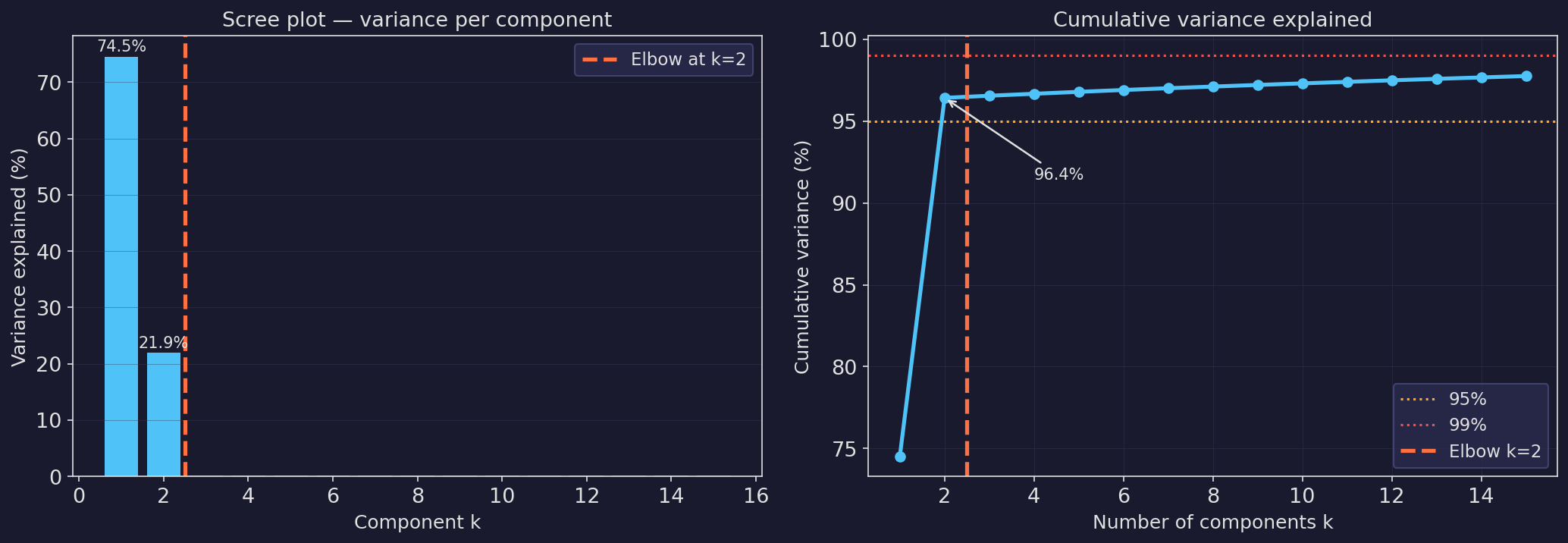
Scree plot (left) and cumulative variance plot (right) for the synthetic EELS stack. The elbow at \(k=2\) separates signal components (large bars) from noise components (flat floor).
  • Plot the variance explained \(\lambda_k / \sum_k \lambda_k\) (or \(\sigma_k^2\)) for each component.
  • Signal components: steeply decreasing — each one captures a large portion of variance.
  • Noise components: flat floor — all roughly equal variance (noise is isotropic).
  • Elbow rule: keep components before the curve flattens.
  • Cumulative variance: keep the smallest \(K\) such that \(\geq 95\%\) (or \(\geq 99\%\)) of variance is explained.

Interpreting the scree plot: signal vs noise

  • Above the elbow: components with large \(\sigma_k\) — their eigenspectrum has recognisable physical structure (peaks, edges, background shapes).
  • Below the elbow: components with small \(\sigma_k\) — their eigenspectrum looks like random oscillations; score map looks like spatially uncorrelated noise.
  • Practical check: always inspect the eigenspectrum and score map of the last component you keep and the first one you discard.
  • Variance explained by noise floor: for \(N\) spectra with \(D\) channels, the noise captures roughly \(N \cdot D \cdot \sigma_n^2\) total variance. If the noise floor variance per component is uniform, each noise PC explains \(\approx \sigma_n^2\).
  • 90%/95%/99%: common thresholds — for EELS denoising, 95% is a reasonable starting point.

Choosing K: the 95% rule and parallel analysis

  • 95% cumulative variance rule: keep the smallest \(K\) such that \(\sum_{k=1}^K \lambda_k / \sum_k \lambda_k \geq 0.95\).
  • Parallel analysis (Horn’s test): compare eigenvalues against those from random data with the same shape.
    • Components with \(\lambda_k >\) random \(\lambda_k\) are signal; the rest are noise.
    • More principled than the elbow rule but computationally heavier.
  • Physical prior: if you know the sample has 3 phases + a background model → try \(K = 4\).
  • Practice: use the scree plot as a first pass, then inspect eigenspectra near the boundary.
  • There is no universally correct \(K\) — it depends on the science question.

PCA denoising of EELS: the experiment
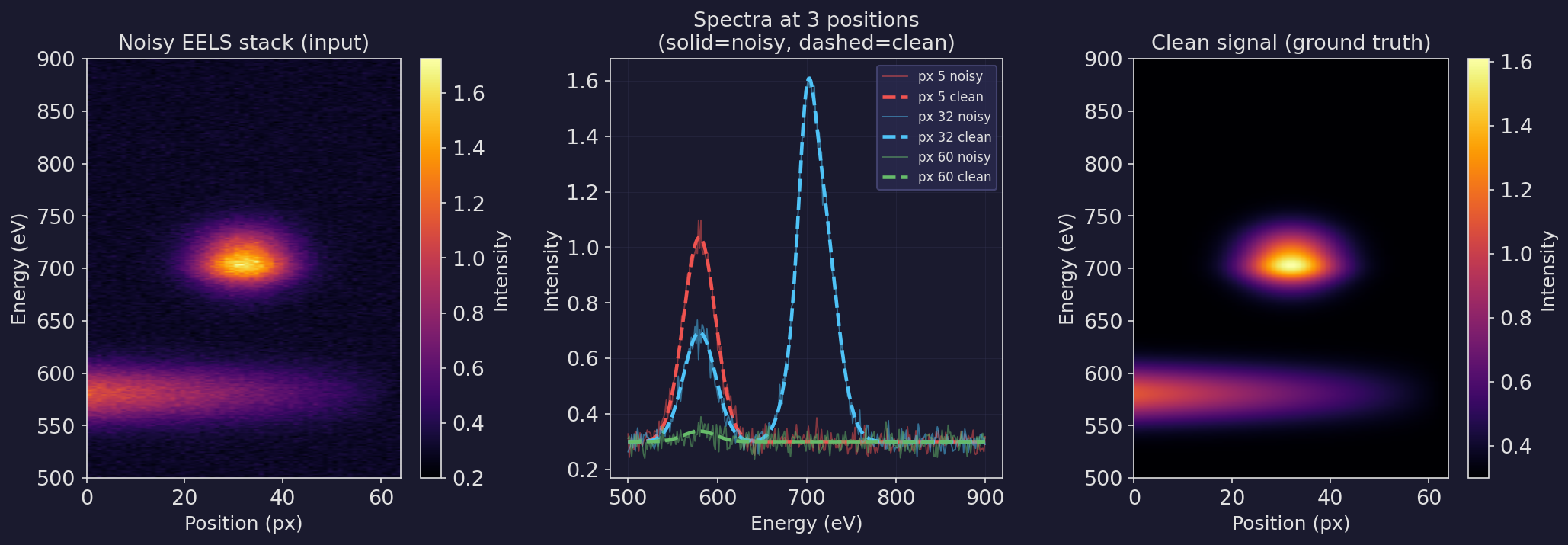
Synthetic EELS line-scan stack: noisy input (left), three sample spectra (centre, solid=noisy, dashed=clean), and clean ground truth (right).
  • Setup: 64-pixel × 300-channel synthetic EELS line scan.
  • Two latent components: Fe-L edge (~710 eV) dominant in the centre; Cr-L edge (~580 eV) dominant at the edges.
  • Noise: Poisson (scale = 500 counts); realistic low-dose EM conditions.
  • Goal: recover the clean spectra from the noisy stack using PCA truncation.
  • Signal is low-rank! Only 2 true latent components → data matrix has rank ≤ 2.

PCA denoising: reconstruction with k components
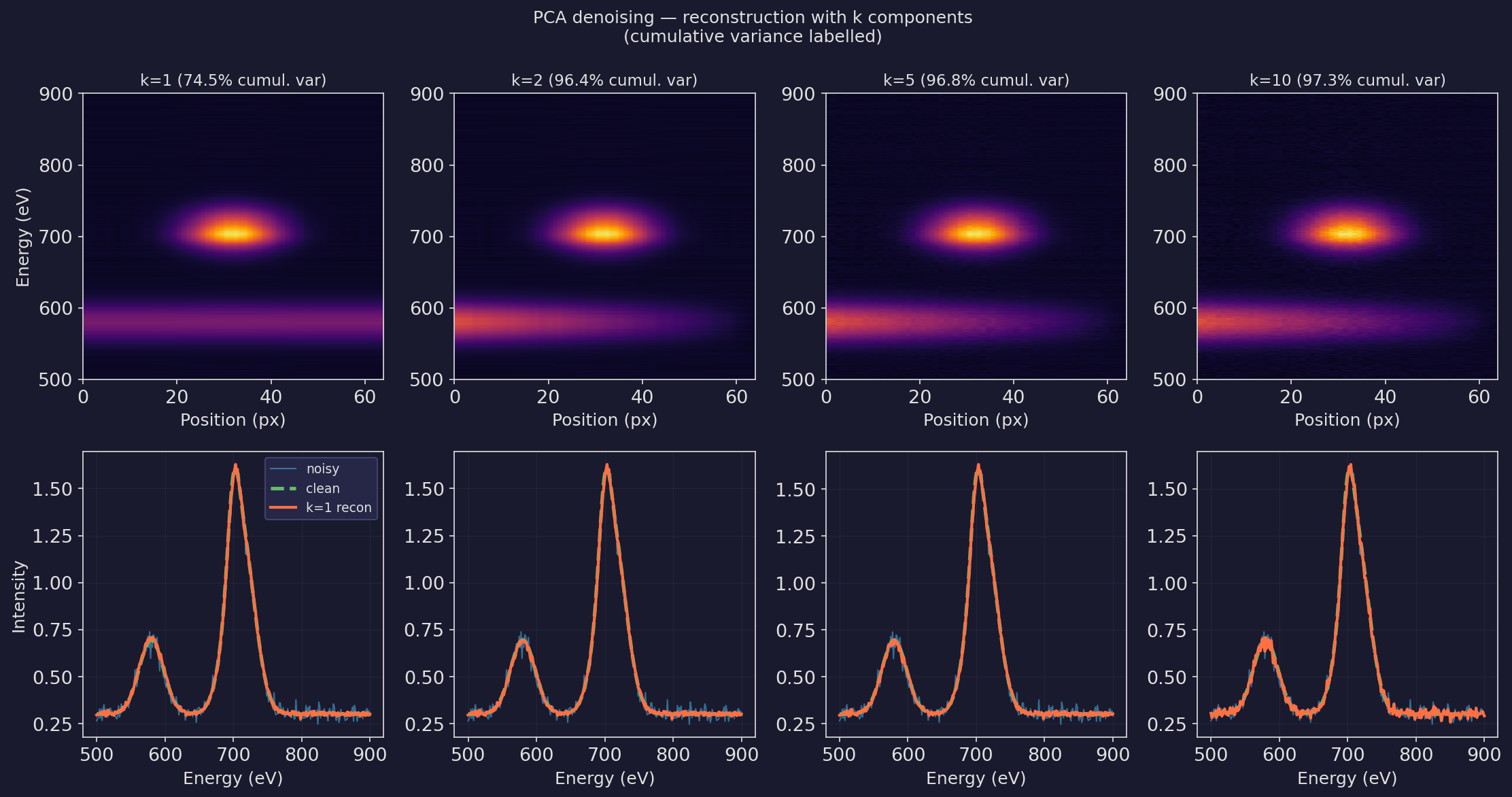
PCA reconstruction of EELS stack with k = 1, 2, 5, 10 components. Top: reconstructed spectral images; bottom: reconstructed spectra at position 24 vs noisy (blue) and clean (green dashed).
  • k = 1: over-denoised — missing the Cr component; systematic error.
  • k = 2: near-perfect — recovers both chemical components; smooth and accurate.
  • k = 5: slightly under-denoised — residual noise from 3 noise components added back in.
  • k = 10: significantly under-denoised — many noise components included.
  • Optimal k = 2 matches the scree-plot elbow. Not coincidence — the elbow marks where truncation switches from “removing noise” to “adding noise.”

Why PCA denoising works: the subspace argument

  • Signal is low-rank: if the spectrum image has \(K\) true chemical components, the clean data lies on a \(K\)-dimensional subspace of \(\mathbb{R}^D\).
  • Noise is full-rank: Poisson noise adds variance in every direction equally — it spreads across all \(D\) dimensions.
  • After SVD: the top \(K\) singular vectors capture the signal subspace; the remaining \(D - K\) directions are dominated by noise.
  • Truncation: project onto the signal subspace (keep top \(K\)), discard the orthogonal complement (noise).
  • Caveat: this argument assumes Gaussian noise (noise is isotropic). Poisson noise has signal-dependent variance, so the noise floor is not perfectly flat — PCA denoising is slightly suboptimal for Poisson statistics.

Eigen-spectra: the spectral shapes of variation
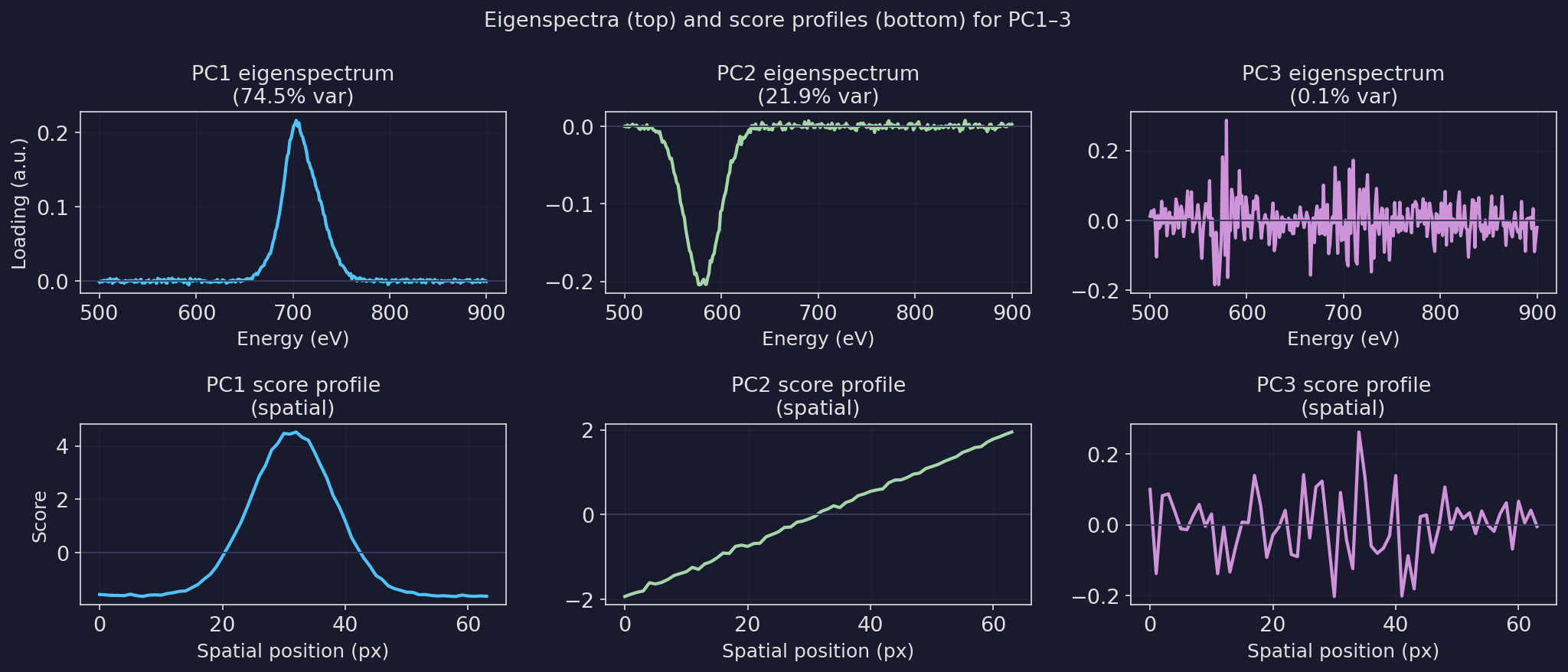
First three eigenspectra extracted from the synthetic EELS stack. PC1 captures the dominant Fe-L variation; PC2 captures the Cr-L contrast; PC3 looks like noise.
  • PC1 eigenspectrum: the direction of maximum variance — here dominated by the Fe-L edge shape.
  • PC2 eigenspectrum: second direction — captures Cr-L contrast (positive Cr-L, negative Fe-L background).
  • PC3+ eigenspectrum: no recognisable peaks — random noise pattern.
  • Note: eigenspectra can have negative values (they are basis vectors, not physical spectra).
  • Physical spectra are reconstructed as: \(\hat{\mathbf{x}}_i = \bar{\mathbf{x}} + c_{i1}\mathbf{v}_1 + c_{i2}\mathbf{v}_2\).

Score maps: chemical images from PCA

  • The score \(c_{ik} = \mathbf{v}_k^T (\mathbf{x}_i - \bar{\mathbf{x}})\) tells how strongly pixel \(i\) expresses PC \(k\).
  • Reshape scores to \((n_y, n_x)\) → a score map — a chemical image of the sample.
  • In our EELS example: the PC1 score map shows high values (bright) where the Fe-L contribution is strong → Fe-rich region map.
  • Score maps can be positive or negative (unlike elemental maps which must be ≥ 0).
  • To get a physically interpretable elemental map: linear unmixing of score maps using known reference spectra.
  • Eigen-micrographs (score maps reshaped to 2-D) are the EM equivalent of eigenfaces in face recognition.

Eigen-micrographs: score maps for 2-D spatial data

  • For a 2-D EELS map (not a line scan), scores have shape \((N, K) = (n_y \cdot n_x, K)\).
  • Reshape to \((n_y, n_x, K)\) → each \([:, :, k]\) slice is an eigen-micrograph: a 2-D chemical map.
  • Physical interpretation:
    • PC1 eigen-micrograph: spatial map of the dominant spectral variation (often sample thickness or total signal).
    • PC2 eigen-micrograph: spatial map of the primary chemical contrast between phases.
  • Bright regions in the k-th eigen-micrograph = pixels where the k-th eigenspectrum is strongly expressed.
  • Compare: eigenfaces in face recognition are the exact same concept applied to images instead of spectra.

Ill-conditioning: when correlated features cause trouble
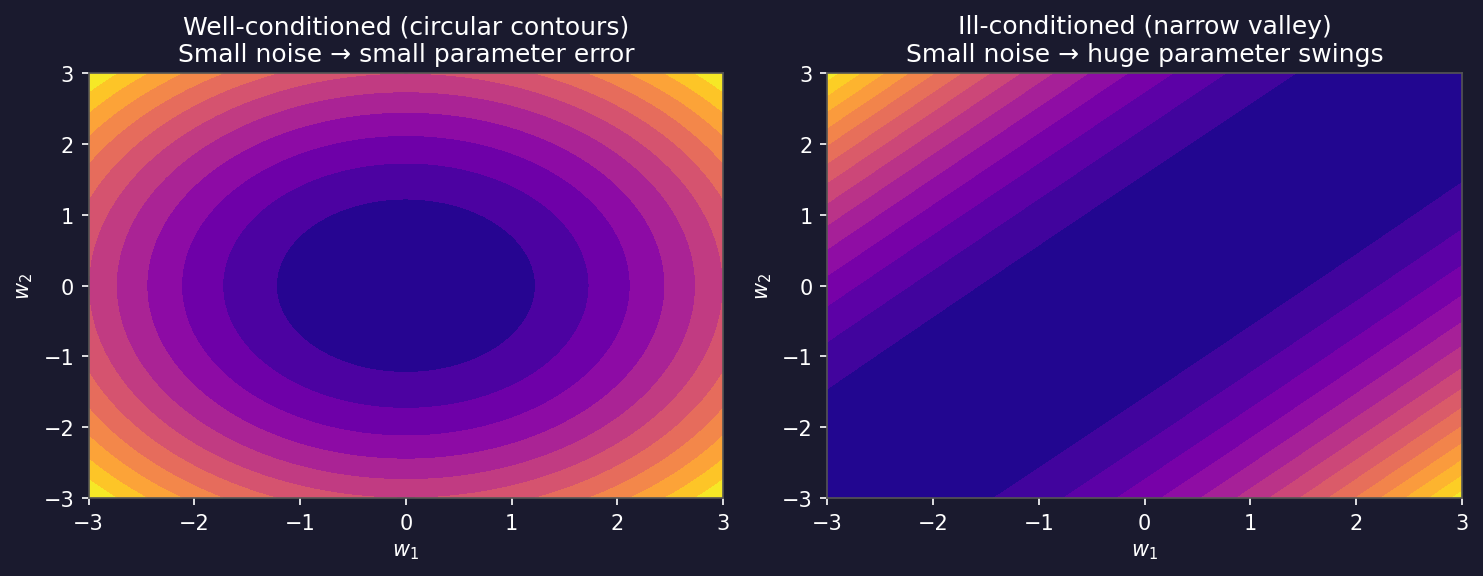
Loss landscape: well-conditioned problem (circular contours, left) vs ill-conditioned problem (narrow valley, right). Small noise → large parameter swing in the ill-conditioned case.
  • Condition number \(\kappa = \sigma_\text{max}/\sigma_\text{min}\) — ratio of largest to smallest singular value.
  • Well-conditioned: \(\kappa \approx 1\) (circular contours). Ill-conditioned: \(\kappa \gg 1\) (narrow valley).
  • Cause: highly correlated features → data matrix nearly singular → small \(\sigma_\text{min}\) → large \(\kappa\).
  • Effect: a tiny change in the data produces huge, unstable swings in the estimated parameters Murphy, Kevin P., (2012).

Why correlated features cause ill-conditioning in EM

  • Scenario: two EDS channels (Fe-K\(\alpha\) at 6.4 keV and Ni-K\(\alpha\) at 7.5 keV) both increase with sample thickness in an FeNi alloy.
  • Forming a regression matrix from both channels → two nearly parallel column vectors → near-singular \(\mathbf{X}^T\mathbf{X}\) → high \(\kappa\).
  • PCA as a cure: PCA rotates to the principal directions. In the new basis, the directions are uncorrelated by construction (orthogonal). The PCA-transformed data matrix has no correlated columns.
  • Practical rule: if your condition number is \(> 10^3\) and you are fitting a linear model, standardise your features (subtract mean, divide by std) and consider PCA pre-processing or Ridge regularisation.
  • Fitting with highly correlated features gives wildly uncertain coefficients even when the prediction accuracy looks fine.

Ill-conditioning: a quick diagnostic

  • Check condition number: np.linalg.cond(X) — if \(> 10^6\), you have a serious problem.
  • Variance–inflation factor (VIF): for each feature, regress it on all others. High \(R^2\) → high VIF → high collinearity.
  • Standardise first: features on vastly different scales (counts vs kV vs nm) create artificial ill-conditioning. Always subtract the mean and divide by the standard deviation before linear modelling.
  • PCA as pre-processing: project features onto the first \(K\) principal components (choose \(K\) to drop near-zero singular values). The resulting \(K\) features are guaranteed to be uncorrelated.
  • Ridge regularisation (Week 4): adds \(\lambda\mathbf{I}\) to \(\mathbf{X}^T\mathbf{X}\), lifting all eigenvalues above \(\lambda\) — quick fix when you want to keep all features.

Limits of linear methods and where PCA fails

  • PCA is optimal for linear, Gaussian-noise problems. For Poisson noise (low-dose EELS), it is approximately optimal for high counts but suboptimal at low counts.
  • PCA fails when spectral variation is non-linear: peak positions shift with composition (XRD peak shift with lattice parameter); peak shapes change non-linearly (EELS fine structure). The data cloud curves — it does not lie on a flat hyperplane.
  • Negative values: PCA loadings can be negative, but spectra are non-negative. PCA does not respect this physical constraint; NMF does.
  • Rare phases: a phase occupying 1% of pixels may contribute <1% of total variance and fall below the noise floor. PCA will erase it.
  • These limits motivate Week 8: autoencoders learn a non-linear low-dimensional representation — the natural generalisation of PCA.

Looking ahead — Week 4

  • Topic: “Regression, gradient descent & honest validation”
  • Linear regression as projection (building directly on today’s geometry).
  • Gradient descent: how to find \(\hat{\mathbf{w}}\) without inverting \(\mathbf{X}^T\mathbf{X}\).
  • Ridge and Lasso regularisation: systematic cures for ill-conditioning.
  • Cross-validation: how to get an honest estimate of generalisation error.
  • Prerequisite: complete the Week 3 notebook; understanding scores and loadings is needed.

Self-study this week

  • Notebook: notebooks/week03_pca_eels.ipynb — “PCA denoising of a synthetic EELS stack.”
    • Build a synthetic EELS line-scan (two latent EELS components + Poisson noise).
    • Compute SVD and plot the scree plot.
    • Reconstruct with different numbers of components; show that k=2 is optimal.
    • Exercise: choose K yourself and justify from the scree plot.
  • Open in Colab: no local installation needed; first cell installs all dependencies.
  • Goal: understand the full PCA pipeline (center → SVD → choose K → reconstruct) before Week 4.
  • Must-know review: check _shared/exam_mustknow.md — Week 3 statements are now filled.

Continue

References

Pattern recognition and machine learning, Christopher M. Bishop.
EELS elemental mapping with unconventional methods i. Theoretical basis: Image analysis with multivariate statistics and entropy concepts, Ultramicroscopy, Patrick Trebbia & Nicolas Bonnet.
Spatially resolved characterization of lead zirconate titanate using valence electron energy-loss spectroscopy, Ultramicroscopy, Michel Bosman, Masashi Watanabe, Duncan TL Alexander, & Vicki J Keast.
Machine learning: A probabilistic perspective, Kevin P. Murphy.