Machine Learning in Materials Processing & Characterization
Unit 2: Physics of Data Formation


Prof. Dr. Philipp Pelz

FAU Erlangen-Nürnberg

FAU Logo IMN Logo CENEM Logo ERC Logo Eclipse Logo

01. From Physical Sensing to ML

  • How does a material property become a data point?
  • Transition from physical process \(\xi(t)\) to digital value \(x_i\).
  • Understanding the physics of sensing is crucial for selecting appropriate ML models (priors).
  • Physics of Sensing: From photons to digits.

01b. Learning Outcomes

Prerequisite (MFML Unit 2): feature matrix \(\mathbf{X}\), SVD, PCA, scree plots, standardization, low-rank approximation, eigen-microstructures.

By the end of this unit you can:

  1. Describe the measurement chain from physical state to digital value.
  2. Apply the Nyquist–Shannon theorem to assess sampling adequacy and recognize aliasing artifacts.
  3. Match physical noise processes to the right likelihood / loss function (Gaussian→MSE, Poisson→Poisson NLL, Weibull→reliability).
  4. Distinguish aleatory from epistemic uncertainty and decide when to collect more data.
  5. Read detector moments (mean, variance, skew, kurtosis) as physical diagnostics rather than abstract statistics.
  6. Interpret PCA components in terms of materials physics — and recognize when a linear basis fails.
  7. Apply K-means and t-SNE for unsupervised clustering and visualization in the PCA-reduced space.

02. The Five Fundamental Probes

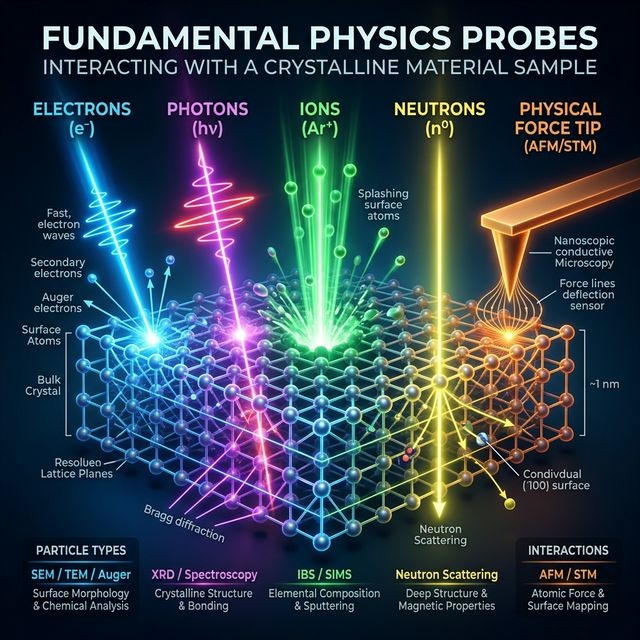
To understand data, we first ask: What is probing the sample?

  1. Electrons: Charged, low mass. High spatial resolution.
  2. Photons: Massless, uncharged. Penetrating, probes bonds & crystals.
  3. Ions: Massive, charged. Huge momentum transfer (sputtering).
  1. Neutrons: Massive, uncharged. Deep nuclear penetration.
  2. Physical Forces: Van der Waals, Pauli repulsion, tunneling (macroscopic/nanoscale probes).
  • The choice of probe dictates the physical interaction, which determines the resulting data format (2D projection vs 3D volume, surface vs bulk).
03. Electron Interactions

Physics of the Probe:

  • Electrons are negatively charged and have low mass.
  • Strong Coulomb interactions with both nucleus and electron cloud.
  • High interaction cross-section = low penetration depth (surface sensitive).
  • Easily focused using magnetic lenses to sub-Ångström spot sizes.

Information & Data Format:

  • Elastic Scattering (Diffraction): Provides crystal structure (e.g., SAED).
  • Inelastic Scattering (Energy Loss): Yields chemical/bonding information (EELS/EDXS).
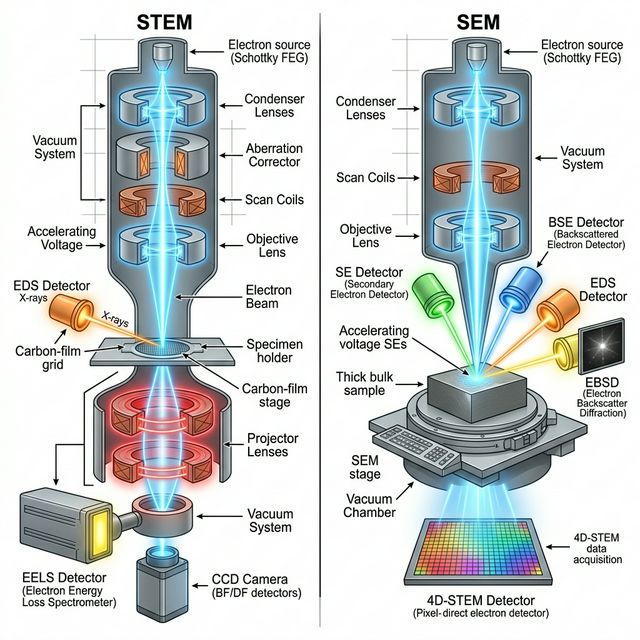
  • Data: High-resolution 2D real-space images (SEM/STEM), 2D reciprocal-space diffractions, or 1D spectra.
04. Photon Interactions (Vis & X-Ray)

Physics of the Probe:

  • Electromagnetic waves (\(E=h\nu\)). They interact primarily with the electron cloud.
  • Visible/IR: Low energy. Probes molecular bonds, vibrations, and bandgaps (Raman, FTIR).
  • X-rays: High energy. Probes core-level electrons and long-range crystal periodicity (XRD, XPS). Highly penetrating.

Information & Data Format:

  • Transverse wave-nature means no magnetic lenses \(\to\) harder to form sub-nm real-space probes compared to electrons.
  • Excels at yielding bulk, macroscopic averages.
  • Data: Often collected as 1D spectra (Intensity vs. Energy/Wavenumber/\(2\theta\)) or 2D diffraction spots.
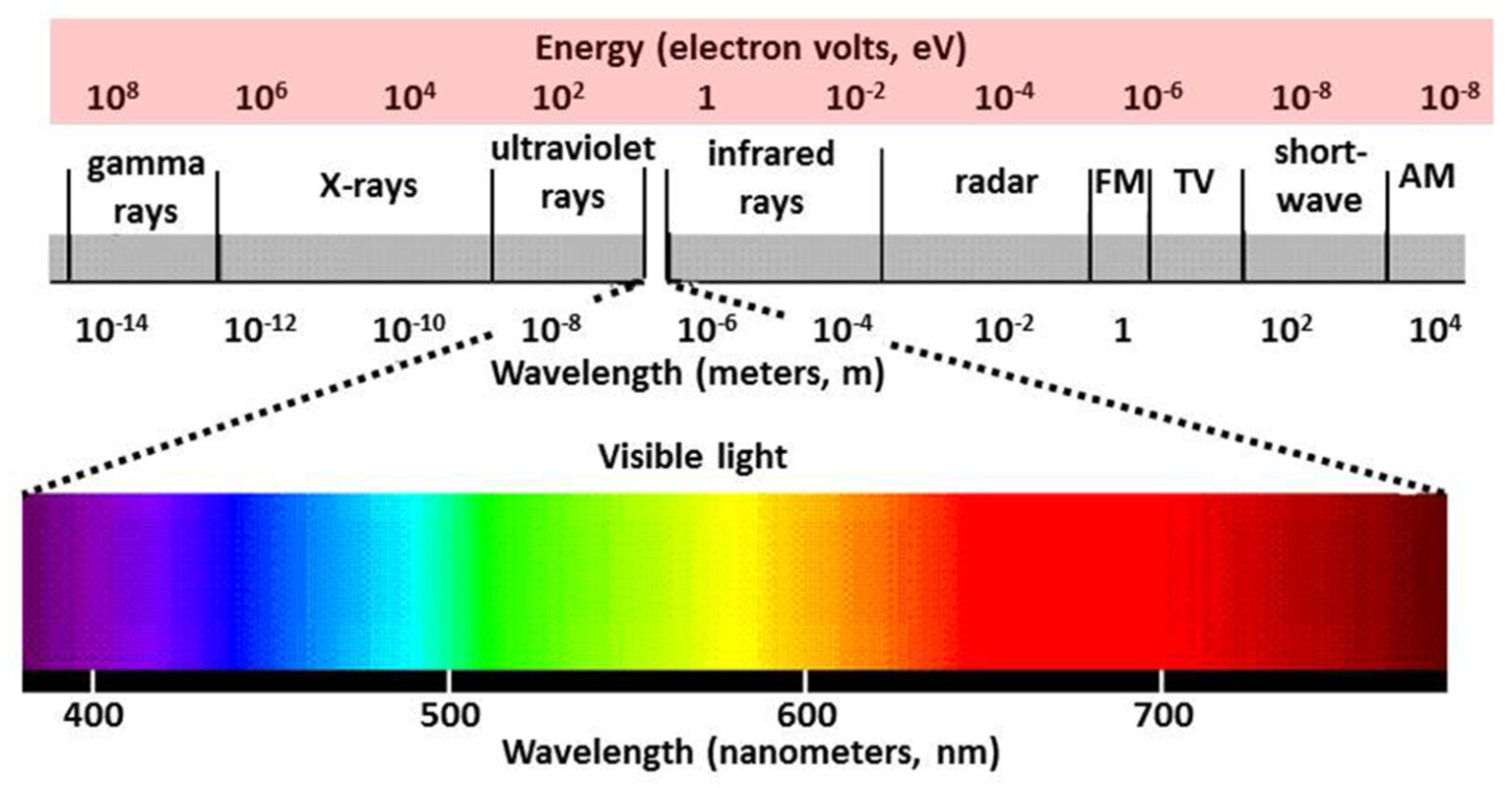
Electromagnetic spectrum

05. Massive Particles: Ions & Neutrons

Ions:

  • Massive, charged (e.g., Ga\(^+\), He\(^+\)).
  • Transfer huge momentum (nuclear stopping).
  • Used for milling/sputtering (FIB) and direct mass identification via Time-of-Flight (Atom Probe Tomography).
  • Data: Focuses on direct 3D atomic reconstructions mapping isotopic mass to \((x,y,z)\) coordinates.
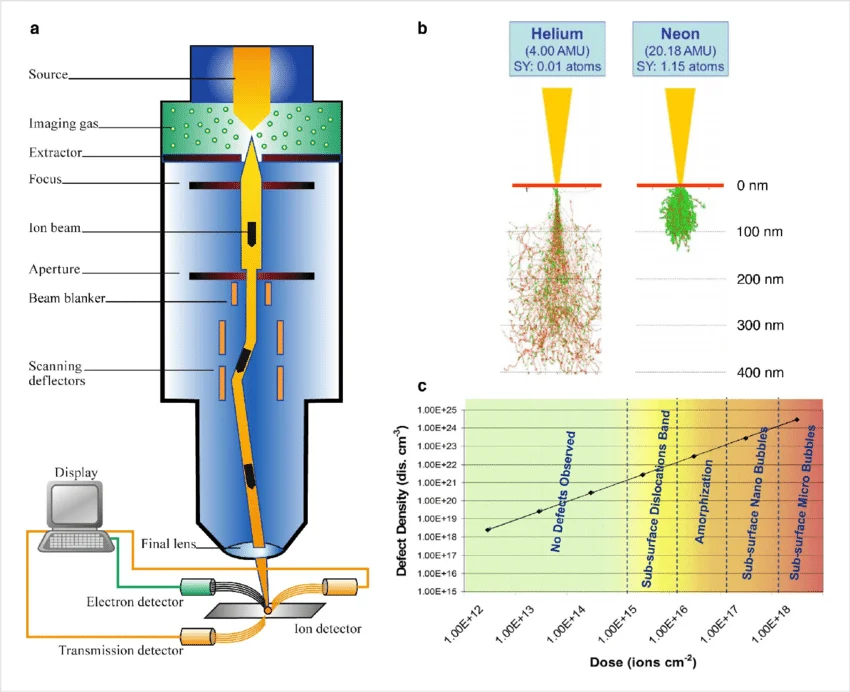
Helium Ion Microscope

Neutrons:

  • Massive, neutral.
  • Interact only with the nucleus (strong force) and magnetic spin.
  • Extremely deep penetration (can probe inside bulk steel parts).
  • Data: Isotope-specific scattering (can easily distinguish Hydrogen from Deuterium). Magnetic structure diffraction.

06. Physical Probes & Forces

Physics of the Probe:

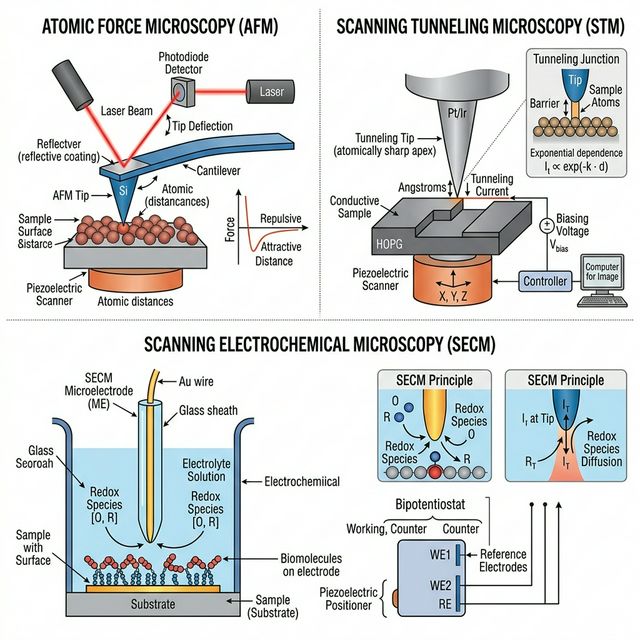
  • A physical, nanoscopic tip interacts directly with the sample surface.
  • Relies on fundamental forces: Van der Waals, electrostatic, or Pauli exclusion (repulsion).
  • In Scanning Tunneling Microscopy (STM), it measures quantum electron tunneling probability.

Information & Data Format:

  • Atomic Force Microscopy (AFM): Measures cantilever deflection via laser tracking.
  • Yields true 3D spatial height maps (topography) of the surface, rather than a 2D projection.
  • Data: 2D Topographic maps \(Z(X,Y)\), or Force-Distance curves measuring mechanical stiffness/adhesion.
07. Sensors as Transducers

  • Sensors convert physical stimuli into electrical/digital signals.
  • Stimuli: Photon intensity, electron scattering, temperature, stress.
  • The mapping \(f: \text{Physical State} \to \text{Digital Representation}\).
  • Every sensor has a characteristic transfer function and noise profile.

08. Example: CMOS Detectors for Optical Imaging

  • Principle: Photons generate electron-hole pairs in a semiconductor.
  • Architecture: Active Pixel Sensor (APS) – each pixel has its own amplifier.
  • Transfer Function: Photons \(\rightarrow\) Charge \(\rightarrow\) Voltage \(\rightarrow\) Digital Number.
  • Characteristics:
    • High frame rates and parallel readout.
    • Susceptible to readout noise and dark current (thermal electrons).
    • High quantum efficiency for visible light.

09. Example: Scintillation Detectors (Indirect)

  • Targets: High-energy X-rays or fast electrons (e.g., in EM).
  • Two-Step Process:
    1. Incident particle hits a scintillator (e.g., YAG, CsI).
    2. Scintillator emits a flash of visible light.
    3. Light is collected by a standard CMOS/CCD.
  • Trade-offs:
    • Pro: Protects the silicon sensor from radiation damage.
    • Con: The generated light scatters within the scintillator crystal.
    • Result: Broad Point Spread Function (PSF) \(\to\) Loss of spatial resolution (blurring).

10. Example: Direct Detectors

  • Targets: X-rays and high-energy electrons (e.g., Cryo-EM).
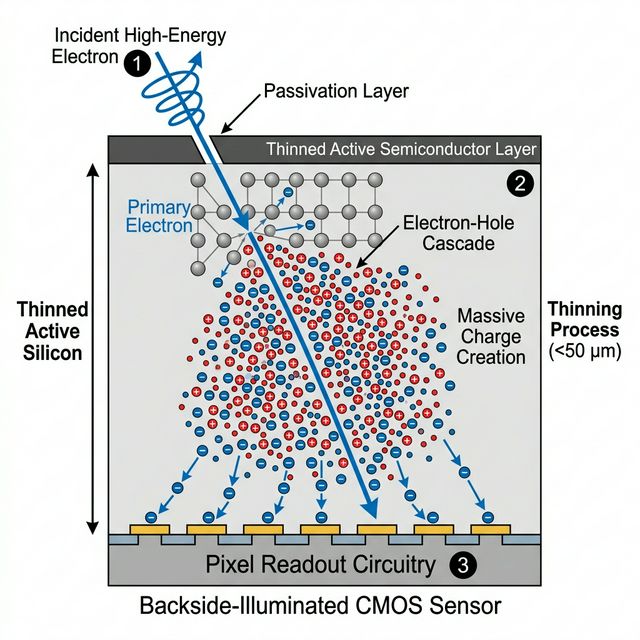
  • Direct Process: Incident particle enters a thinned semiconductor layer directly.
  • Physics: One incident high-energy particle generates a massive electron-hole cascade.
  • Key Advantages:
    • No scintillator intermediate \(\to\) no optical scattering.
    • Extremely sharp Point Spread Function (PSF).
    • High SNR allows precise single-particle counting with near-zero noise.
11. Spectrometers: Energy Resolution in EDXS

  • Principle (Energy \(\to\) Charge):
    • An X-ray photon strikes a semiconductor detector (e.g., Silicon Drift Detector).
    • It creates \(N\) electron-hole pairs proportional to its energy: \(N = E / \epsilon\).
    • Example: A 1 keV X-ray creates \(\sim 260\) pairs in Si (\(\epsilon \approx 3.8\) eV).
  • Measurement:
    • The total collected charge is converted to a voltage pulse.
    • Pulse height \(\propto\) incoming X-ray energy.
  • Resolution Limits:
    • Governed by counting statistics (Fano noise) and electronic readout noise.
    • Typical energy resolution is around \(\sim 130\) eV.

12. Spectrometers: Energy Resolution in EELS

  • Principle (Energy \(\to\) Space):
    • Fast electrons pass through the sample, undergoing inelastic scattering (losing energy).
    • A magnetic prism then bends the electron trajectories (Lorentz force).
    • Slower (energy-loss) electrons are bent slightly more than faster (zero-loss) ones.
  • Measurement:
    • The magnetic prism spatially disperses the electrons across a detector (e.g., CMOS or Direct Detector).
    • Pixel position on the detector directly maps to energy loss \(\Delta E\).
  • Resolution Limits:
    • Governed by the energy spread of the electron gun (e.g., Cold FEG restricts spread) and spectrometer aberrations.
    • State-of-the-art can achieve \(\sim 10\) meV resolution!

13. Continuous to Discrete Mapping

  • Sampling: Measuring at discrete points \(\tau_i\).
  • Neuer’s Sampling formula (Neuer et al. 2024): \[x_i = \xi(\tau_i + \delta t) + u_x\]
    • \(\xi\): Underlying physical truth.
    • \(\delta t\): Timing jitter/uncertainty.
    • \(u_x\): Amplitude noise/uncertainty.

14. Temporal and Spatial Sampling

In Characterization:

  • Pixel pitch (spatial resolution)
  • Frame rate (temporal resolution)
  • Energy binning (spectral resolution)
  • Sampling Rate \(\nu_S = 1/\Delta t\).
  • Spatial frequency \(k = 1/\Delta x\).

15. The Nyquist-Shannon Theorem

  • To fully capture a signal with maximum frequency \(\nu_{max}\), we must sample at least twice as fast: \[\nu_S \ge 2\nu_{max}\]

  • Nyquist Frequency: \(\nu_{Nyquist} = \frac{1}{2} \nu_S\).

  • Frequencies above \(\nu_{Nyquist}\) cannot be resolved and cause artifacts.

16. Aliasing - When Resolution Fails

  • If \(\nu_S < 2\nu_{max}\), high-frequency components are “folded” into lower frequencies.
  • Example: Moiré patterns in TEM when grid resolution and crystal lattice interfere.
  • Example: Wagon-wheel effect in high-speed video.

17. Physical Resolution Limits

  • Optical/Electron diffraction limits (Abbe’s limit).
  • Point Spread Function (PSF): The response of an imaging system to a point source.
  • Measured image = True Object \(\ast\) PSF + Noise.
  • Blurring as a physical prior for convolutional models.

18. Jitter and Temporal Resolution

  • Jitter (\(\delta t\)) in our “clock” during sampling.
  • Leads to phase noise and uncertainty in transient measurements.
  • Crucial in pump-probe experiments and high-speed process monitoring.

19. Finite Rate of Innovation (FRI)

  • If we have prior knowledge of the signal structure (e.g., sum of \(K\) spikes), we can sample below Nyquist.
  • “Sparsity” in the physical process enables compressed sensing.
  • Materials data is often sparse (e.g., atoms in vacuum, defects in a crystal).

20. Sparse Recovery Example (FISTA)

  • Compressed Sensing: Recovering a signal from highly incomplete measurements.
  • We measure \(\mathbf{y} = \mathbf{A}\mathbf{x} + \mathbf{n}\) with \(M \ll N\).
  • L1-Minimization promotes sparsity: \[\hat{\mathbf{x}} = \arg\min_{\mathbf{x}} \frac{1}{2} \|\mathbf{y} - \mathbf{A}\mathbf{x}\|_2^2 + \lambda \|\mathbf{x}\|_1\]
  • FISTA: Accelerated proximal gradient descent method to solve this non-smooth problem efficiently.

21. The FISTA Algorithm (Mathematics)

  • Objective: Minimize a composite function \(F(\mathbf{x}) = f(\mathbf{x}) + g(\mathbf{x})\)
    • Smooth data-fidelity: \(f(\mathbf{x}) = \frac{1}{2}\|\mathbf{y} - \mathbf{A}\mathbf{x}\|_2^2 \implies \nabla f(\mathbf{x}) = \mathbf{A}^T(\mathbf{A}\mathbf{x} - \mathbf{y})\)
    • Non-smooth sparsity prior: \(g(\mathbf{x}) = \lambda \|\mathbf{x}\|_1\)
  • Proximal Gradient Step (ISTA):
    1. Gradient Step: \(\mathbf{v}_k = \mathbf{x}_{k-1} - \gamma \nabla f(\mathbf{x}_{k-1})\)
    2. Proximal Step (Soft-Shrinkage): Evaluates \(\text{prox}_{\gamma g}(\mathbf{v}_k)\) \[\mathbf{x}_k = \text{sign}(\mathbf{v}_k) \max(|\mathbf{v}_k| - \gamma\lambda, 0)\]
  • Nesterov Acceleration (FISTA):
    • Updates the evaluation point using momentum to accelerate convergence from \(\mathcal{O}(1/k)\) to \(\mathcal{O}(1/k^2)\):
    • \(\mathbf{y}_k = \mathbf{x}_k + \frac{t_k - 1}{t_{k+1}}(\mathbf{x}_k - \mathbf{x}_{k-1})\)
    • where \(t_{k+1} = \frac{1 + \sqrt{1 + 4t_k^2}}{2}\)

22. Modeling Sensor Noise

  • Measurements as Random Variables:
    • A digital measurement \(x_i\) is not a deterministic value.
    • Due to physical fluctuations, \(x_i\) is drawn from a probability distribution \(P(x_i | \lambda_i)\).
    • \(\lambda_i\): The “true” underlying physical state (e.g., predicted by a model).
  • Common Noise Models:
    • Gaussian (Normal) Noise: Thermal fluctuations in electronics (readout noise).
    • Poisson Noise: Discrete counting statistics of particles (shot noise for photons/electrons).

23. Noise as a Physical Process

  • Sensors are stochastic processes.
  • Thermal Noise (Johnson-Nyquist): Random electron motion.
  • Shot Noise: Counting statistics for photons/electrons (Poisson process).
  • Noise is not just “error”; it follows physical laws.

24. Aleatory vs. Epistemic Uncertainty (Neuer et al. 2024)

Aleatory (Statistical):

  • Inherent randomness (dice).
  • Cannot be reduced by more data.
  • e.g., thermal noise.

Epistemic (Knowledge-based):

  • From “lack of knowledge.”
  • Can be reduced by more data/better models.
  • e.g., calibration errors.

25. Physical Noise Models

  • Gaussian: Thermal/Electronic noise.
  • Poisson: Shot noise in EM/X-ray (counting).
  • Weibull: Failure and defect statistics in materials.

25b. The Weibull Distribution: Failure & Strength Statistics

\[p(x; k, \lambda) = \frac{k}{\lambda}\!\left(\frac{x}{\lambda}\right)^{k-1}\!e^{-(x/\lambda)^k}\]

  • Heavily skewed (not bell-shaped).
  • \(k\): shape — controls skewness and failure mechanism.
  • \(\lambda\): scale — characteristic life / strength.
  • Captures both early failures (\(k<1\)) and wear-out (\(k>1\)).

Materials use cases:

  • Fatigue life prediction.
  • Ceramic strength statistics.
  • Reliability engineering & time-to-failure.
  • Defect density in thin films.

ML consequence: Using MSE on Weibull-distributed targets gives wrong confidence intervals. Use a Weibull NLL or transform to log-space.

25c. Weibull Distribution: Interactive Explorer

  • Drag \(k\) (shape) and \(\lambda\) (scale) and watch the PDF, CDF and hazard \(h(x)\) change.
  • Regime banner tells you which failure mode:
    • \(k<1\) → infant mortality,
    • \(k\approx 1\) → random,
    • \(k>1\) → wear-out,
    • \(k\approx 3.4\) → near-Gaussian.
  • Key points on the PDF: mean, median, mode — note how they separate with skewness.

26. From Gaussian Noise to MSE Loss

  • Gaussian Likelihood: \[P(x_i | \hat{x}_i) = \frac{1}{\sqrt{2\pi\sigma^2}} \exp\left( -\frac{(x_i - \hat{x}_i)^2}{2\sigma^2} \right)\]
    • \(x_i\): Noisy observation.
    • \(\hat{x}_i\): Model prediction.
  • Negative Log-Likelihood (NLL): \[-\log P(x_i | \hat{x}_i) \propto (x_i - \hat{x}_i)^2 + C\]
  • Result: Assuming constant variance \(\sigma^2\), minimizing NLL is exactly equivalent to minimizing the Mean Squared Error (MSE).
  • Takeaway: MSE assumes your data has Gaussian noise!

27. From Poisson Noise to Poisson Loss

  • Poisson Likelihood (Shot Noise): \[P(x_i | \hat{x}_i) = \frac{\hat{x}_i^{x_i} e^{-\hat{x}_i}}{x_i!}\]
    • \(x_i\): Observed particle count (integer).
    • \(\hat{x}_i\): Expected count rate.
  • Negative Log-Likelihood (NLL): \[-\log P(x_i | \hat{x}_i) = \hat{x}_i - x_i \log(\hat{x}_i) + \log(x_i!)\]
  • Poisson Loss: Dropping the \(\log(x_i!)\) term yields: \[\mathcal{L} = \hat{x}_i - x_i \log(\hat{x}_i)\]
  • Use Case: Essential for low-dose microscopy, astronomy, and spectroscopy.

28. Bayesian Inference & MAP Estimation

  • Bayes’ Theorem: Inferring the true state model \(\mathbf{\theta}\) from data \(\mathbf{X}\): \[P(\mathbf{\theta} | \mathbf{X}) = \frac{P(\mathbf{X} | \mathbf{\theta}) P(\mathbf{\theta})}{P(\mathbf{X})}\]
  • Maximum A Posteriori (MAP) Estimation: \[\hat{\mathbf{\theta}}_{\text{MAP}} = \arg\max_{\mathbf{\theta}} \left[ \log P(\mathbf{X} | \mathbf{\theta}) + \log P(\mathbf{\theta}) \right]\]
  • Connection to Machine Learning:
    • \(P(\mathbf{X} | \mathbf{\theta})\) is the Likelihood \(\rightarrow\) Minimizing Negative Log-Likelihood gives our Loss Function.
    • \(P(\mathbf{\theta})\) is the Prior \(\rightarrow\) Provides Regularization (e.g., L2 weight decay is a Gaussian prior).

29. Recap: Linear Algebra Toolkit (MFML Unit 2)

You already have the mathematical machinery:

  • Feature matrix \(\mathbf{X}\) (\(m\) samples × \(n\) features).
  • Covariance matrix \(\mathbf{C} = \tfrac{1}{N-1}\bar{\mathbf{X}}^{T}\bar{\mathbf{X}}\) — symmetric, PSD.
  • SVD: \(\mathbf{X} = \mathbf{U}\mathbf{\Sigma}\mathbf{V}^{T}\) — universal factorization.
  • PCA = SVD on centered data; maximizes retained variance; scree plot for choosing \(k\).
  • Low-rank truncation \(\mathbf{X}_k = \mathbf{U}_k\mathbf{\Sigma}_k\mathbf{V}_k^{T}\) — compression & denoising.
  • Standardization / whitening before PCA when units / scales differ.
  • Eigen-microstructures as a linear basis for image data.

In this unit we focus on the physics sitting on top of that math:

  • Which physical modes do PCs correspond to?
  • How does the noise model (Poisson, Gaussian, Weibull) interact with PCA?
  • When does a linear basis fail, and why?
  • What do we do with the reduced representation (clustering, visualization)?

See MFML Unit 2 for derivations; here we apply them.

30. Moments in Detector Language

Mean — the signal level: \[\mu = E[x] = \sum_i x_i\, p(x_i)\]

Variance — the noise level: \[\sigma^2 = E\!\left[(x - \mu)^2\right]\]

For many detectors \(\text{SNR} \approx \mu / \sigma\).

Noise-model constraints on moments:

  • Poisson shot noise: \(\sigma^2 = \mu\) — variance is not a free parameter.
  • Gaussian thermal noise: \(\sigma^2\) independent of \(\mu\) — two distinct parameters.
  • Weibull failure: heavy skew; moments are non-trivial functions of \((k, \lambda)\).

31. Higher Moments as Detector Diagnostics

  • Skewness: asymmetry — non-zero for Poisson at low counts and for Weibull failure data.
  • Kurtosis: tail weight — high when cosmic-ray hits or ion bursts create spikes.
  • Practical use: inspect residual histograms.
    • Fat tails → outliers → use a Huber / robust loss.
    • Skew → wrong noise model → switch the likelihood.

32. Interpreting PCA Components in Materials

PCA components often correspond to physical modes:

  • PC 1: overall intensity — thickness / density variation.
  • PC 2: primary chemical shift, grain rotation, or phase onset.
  • PC 3: secondary phase appearance or defect signature.

Warning: PCA components are mathematical (orthogonal), not physical. Two physical effects can be mixed into one PC, or one effect can be spread across several PCs — always validate against domain knowledge.

When PCA fails: rotations, deformations and phase transitions lie on non-linear manifolds — consider NMF, autoencoders, or Kernel PCA (see MFML Unit 2 / 9).

33. Case Study: Time Series (McClarren) (McClarren 2021)

Hohlraum laser pulse simulation:

  • 30 time-point pulse profiles → 2 principal components.
  • PC 1 ≈ overall pulse scale / height.
  • PC 2 ≈ plateau timing / rise time.
  • Captures 83 % of variance with 2 variables.
  • A 30-dim physical process collapsed to a 2-D diagnostic plane.
  • Each PC has a clear physical meaning — rare for PCA, but achievable for smooth time series.
  • Models, experiments, and uncertainty bounds can all be tracked in the same PC plane.

34. Case Study: Hyperspectral Imaging (McClarren 2021)

  • 2051 wavelengths per pixel → 4 principal components.
  • Identifies distressed vs. healthy vegetation from non-visible spectral signatures.
  • Same workflow applies to EDS / EELS hyperspectral data in materials: per-pixel spectra → few-component decomposition → phase maps.

35. K-means Clustering

  • Unsupervised: find \(K\) natural groupings in the data.
  • Minimize the within-cluster sum of squares:

\[L = \sum_{k=1}^{K} \sum_{\mathbf{x}_i \in C_k} \|\mathbf{x}_i - \boldsymbol{\mu}_k\|^2\]

  • Initialize \(K\) centroids → assign points → update centroids → repeat.
  • Simple, fast, but requires choosing \(K\) in advance.
  • Materials context: automatic phase mapping in EDS / EELS hyperspectral datasets.

35b. Choosing \(K\): The Elbow Method

  • Plot the within-cluster loss \(L\) versus \(K\).
  • Elbow: adding more clusters yields diminishing returns.
  • Mirrors the PCA scree plot in spirit.
  • Alternatives: silhouette score, gap statistic.

In materials, prior knowledge often constrains \(K\):

  • Expected number of phases.
  • Known crystallographic classes.
  • Process-set regimes.

Note

When the elbow is ambiguous, combine quantitative criteria with domain knowledge — e.g., do \(K=4\) clusters correspond to known phases?

36. t-SNE: Visualizing High-Dim Manifolds

t-Distributed Stochastic Neighbor Embedding

  • Maps high-dim data to 2D/3D for human visualization.
  • Preserves local structure (neighbors stay neighbors).
  • Does not preserve global distances.

36b. Why the “t”? Heavy Tails for Better Separation

  • High-dim: Gaussian similarities between neighbors.
  • Low-dim: Student-\(t\) / Cauchy distribution (heavy tails).
  • Heavy tails let dissimilar clusters spread out in 2D without crowding near clusters.

Fashion-MNIST example (McClarren 2021):

  • \(28 \times 28\) pixel images → 784-D space.
  • t-SNE reveals “islands” of T-shirts, shoes, dresses, …
  • Structure discovered purely from pixels — no labels.

Materials analogue: apply t-SNE to a stack of micrographs and watch microstructure types separate.

Important

t-SNE is stochastic and depends on perplexity. Run it multiple times and vary perplexity before trusting any visual cluster.

37. Summary & Key Takeaways

  1. Sampling Physics: Nyquist, aliasing, and resolution are the physical limits of your data — no ML can recover what the sensor did not capture.
  2. Sensors as transducers: CMOS, scintillator, direct detector, EDXS, EELS — each has a distinctive PSF and noise fingerprint.
  3. Uncertainty: match the noise model (Gaussian → MSE, Poisson → NLL, Weibull → reliability) to the right loss. Separate aleatory (irreducible) from epistemic (reducible).
  4. Bayes’ theorem unifies physics prior + measurement likelihood → posterior — and recovers Ridge / Lasso regularization as special cases.
  5. Reduction (from MFML Unit 2), interpreted physically: PCA components may correspond to physical modes; validate against domain knowledge; non-linear manifolds need non-linear tools.
  6. Clustering & visualization: K-means (with elbow) and t-SNE (with heavy tails) uncover hidden structure — in PC space first, for robustness.
McClarren, Ryan G. 2021. Machine Learning for Engineers: Using Data to Solve Problems for Physical Systems. Springer.
Neuer, Michael et al. 2024. Machine Learning for Engineers: Introduction to Physics-Informed, Explainable Learning Methods for AI in Engineering Applications. Springer Nature.